Eight cold-stunned sea turtles crawl to Atlantic after East End rehab
A large crowd packed Tiana Beach in Hampton Bays one evening last week, phones held high, as eight sea turtles that nearly froze to death this past winter returned to the Atlantic.
Shelter Island had its share of “cold-stunnned” turtles that were rescued. Last December, Shelter Island Animal Control Officer Jenny Zahler, had calls for two green sea turtles not moving and stranded, one at Reel Point and one on Shell Beach. The Reel Point turtle was called in by KC Bailey, and Jackie Brewer discovered the Shell Beach turtle.
“They did exactly the right thing,” Officer Zahler said. “They called me immediately. Anyone can call, anytime, and I’ll respond.”
Officer Zahler quickly determined that the two turtles found were cold-stunned, which, as Reporter writer Cindy Belt has written, means that “occasionally turtles get trapped by rapidly chilling waters. Cold-stunning occurs when a dramatic decrease in water temperatures makes it impossible for these cold-blooded animals to swim effectively and migrate to warmer water. Without proper intervention, a cold-stunned sea turtle will inevitably die of exposure and hypothermia.”
Officer Zahler made arrangements for transport of the turtles to the New York Marine Rescue Center at the Long Island Aquarium in Riverhead. The green sea turtle found at Reel Point was too far gone to bring back to life. The other will be cared for and rehabilitated before being returned to bays.
Last week staff and volunteers from the New York Marine Rescue Center in Riverhead carried the rehabilitated turtles down the beach in blue-sided transport boxes as police officers cleared a path through the spectators.
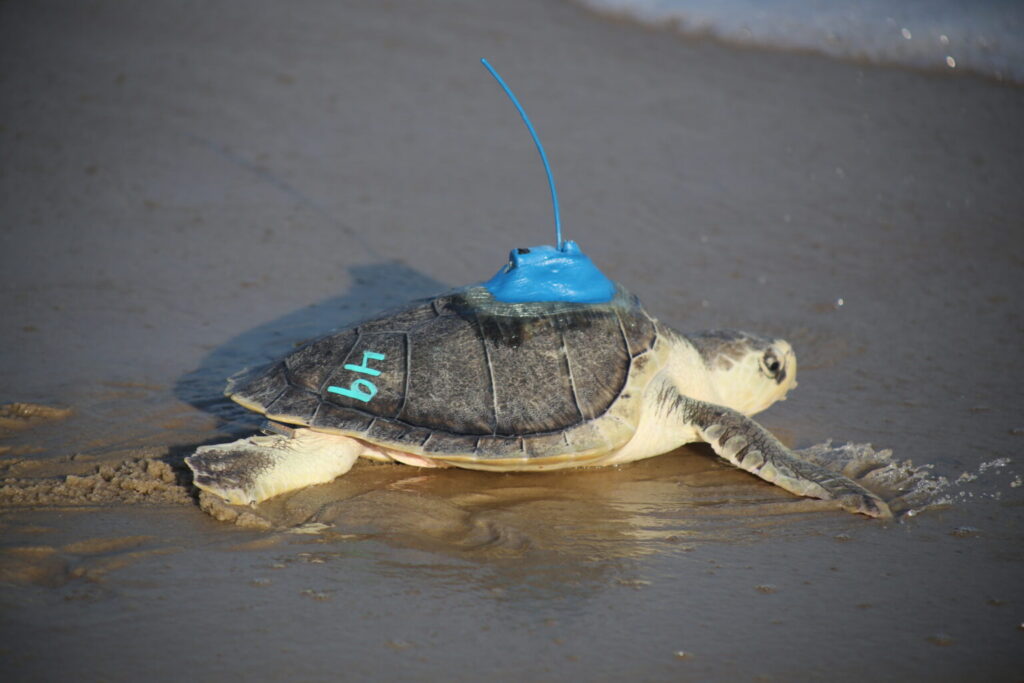
Brightly painted identification numbers marked their shells, while some carried bright-blue satellite transmitters with thin antennas rising from their backs.
One by one, the turtles were cradled to the waterline and placed on the wet sand. Some lingered at the edge of the surf before the waves pulled them in. The crowd clapped and cheered each time one disappeared beneath the water.
The group included four critically endangered Kemp’s ridleys and four Atlantic green sea turtles, all of which washed ashore after becoming cold-stunned in waters off New York during the winter.
“Every sea turtle we return to the ocean represents a second chance for an animal that would not have survived without intervention,” Executive Director Maxine Montello said in a statement.
The tags are part of a growing research partnership with the state Department of Environmental Conservation, which is funding 20 satellite transmitters for rehabilitated hard-shelled turtles over the next two years. The public will be able to follow the four tagged turtles through live tracking maps on the rescue center’s website.
Sea turtles are cold-blooded. Those that don’t migrate south before water temperatures drop below about 55 degrees can get trapped around Long Island. Their body temperatures fall, they stop eating, and eventually they can’t swim — strong winds and tides do the rest, pushing them ashore.
That winter also froze local creeks and packed parts of Peconic Bay with ice, tearing apart docks and fishing equipment.
The Riverhead-based center has now returned 17 rehabilitated turtles to the wild this season. Another 23 cold-stunned turtles remain in its care, with most expected to be released later this summer.
Last September, the center released Pegasus, a 250-pound female loggerhead, from the same Hampton Bays beach after six months in its outdoor tank.