Suffolk Closeup: School ban on student phones
For a little more than a year the New York State law commonly referred to as the Distractions-Free School Law and also Phone-Free Schools Law has been in force and appears to be generally successful. The law’s restrictions began with the start of the school year in September 2025.
The statewide prohibition followed bans in several school districts in Suffolk County. Shelter Island was a pioneer with teacher Peter Miedema leading the way.
It was a major initiative of Gov. Kathy Hochul (D), indeed in political TV commercials in her recent re-election campaign she cited it as the first on her list of claimed accomplishments.
The law, with its passage by the State Legislature and signing by Hochul, became part of the Education Law of New York. It bans the use by students during the school day of “any smartphone, tablet, smartwatch, or other device capable of connecting to the internet and enabling the user to access content on the internet, including social media applications.”
The term “school day” is defined as “every instructional day … during all instructional time and non-instructional time, including, but not limited to homeroom periods, lunch, recess, study halls” and in buildings or land “within the real property boundary line” of a school. There are exceptions in it including permission by a teacher or principal to use such a device “for a specific educational purpose;” an emergency; and for translation services.
Reaction to it?
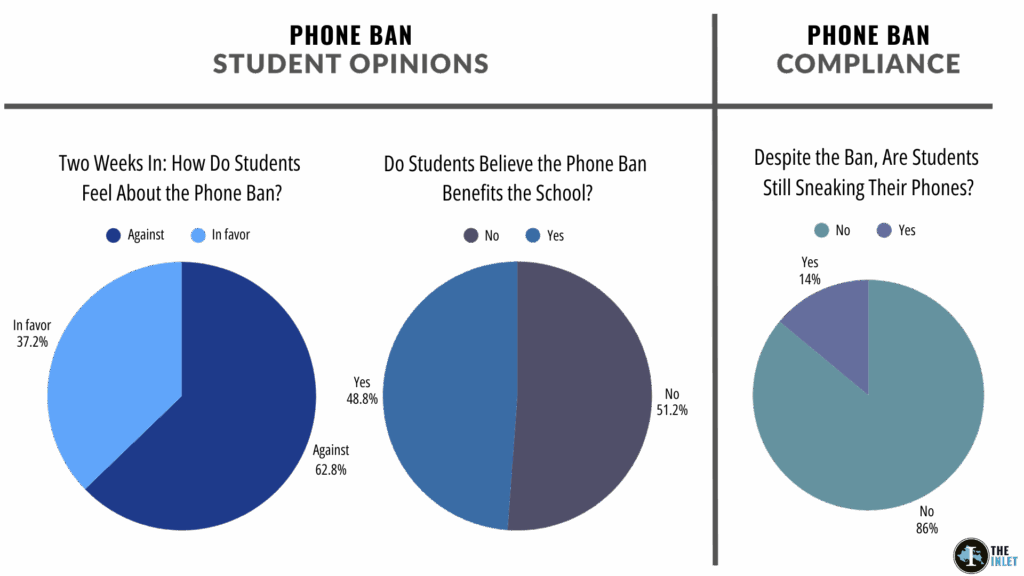
On Shelter Island, The Inlet, the Shelter Island School newspaper, published a survey early on, two weeks into the State ban, involving 50 secondary students and found “opinions are split.” Some “37.2% of secondary students support the new law, while 62.8% oppose it,” The Inlet reported, and “half of students — 48.8% — say the policy benefits the school, compared with 51.2% who say it does not.”
In Riverhead, “District-free schools law brings more focus, student engagement to Riverhead classroom,” was the headline of a story by editor Denise Civiletti on RiverheadLOCAL. “Cellphone use was already banned in classrooms here, but enforcement of the ban in the high school remained inconsistent, school officials say,” said the piece. “Since the bell-to-bell ban was implemented by law in September, administrators and teachers are seeing many of the same benefits extolled by the government, though some staff and students question whether an all-day, everywhere ban goes too far.”
Newsday ran a story headlined: “NYS school cellphone ban: LI educators say students talking more, engaging in class since ban took effect.”
The article began: “Before the school year started, Farmingdale High School Principal Jed Herman worried his job would be consumed with enforcing the state’s bell-to-bell cellphone ban. “’I thought I’d be more of a phone police,’ he said recently. ‘I thought I would constantly fight this battle. But in reality, that didn’t happen.”
The piece also cited a survey by the New York State United Teachers union that showed “overwhelming support” for the ban “with educators reporting students were more ‘present and participative during lessons’ and there were “‘considerably more positive’ social interactions among students.”
Two months ago on the anniversary of the law taking effect, Hochul reported on a “statewide survey” involving “nearly 600 teacher and school administrators.” Her announcement was headed: “Approximately 80% Reported Positive Outcomes Including Better Student Engagement and Improved Social Connections.” So-called smart phones were not a problem in teaching when I started out as a professor at SUNY at Old Westbury in 1978. But a few decades later they arrived and I needed to include in the syllabi for my classes the statement: “Smart phones and similar electronic devices, because they divert a student’s attention, are not to be used during class. Please put your smart phone or similar device away and forget about texting or checking on email during class.”
I explained to my students that my issue with smart phones being used in class wasn’t personal. Having one of these devices with me was, I said, indispensable and every once in a while when I couldn’t find mine, panic broke out. But, I continued, I believed using a smart phone in class and multi-tasking was impossible, that it would interfere with learning.
The state law applies to all K-12 public schools, charter schools, and Boards of Cooperative Educational Services (BOCES) schools — not colleges or universities.
As to the wider world, Newsday ran a story this January headlined: “Phone ban favored worldwide.” It reported that “a new study found parents across the globe want the smart devices kept out of classrooms. In a research letter published in JAMA Pediatric,” Professor Lauren Hale of the Department of Family Population & Preventive Medicine at Stony Brook University’s Renaissance School of Medicine “and her colleagues found more than 75% of adult respondents in 35 countries supported smart-phone bans in school … The team analyzed data from UNESCO’s 2023 Global Monitoring Report which surveyed the opinions of more than 35,000 adults.”
The findings “build upon a previous study” in which “25% of the 300 adolescents surveyed spent more than two hours on their phone during the school day … Social media use amounted to most of that time, Hale said,” adding “these types of studies are leading to actual policy change … leading to better outcomes for youth.”