Gone Fishing: One. More. Bass.
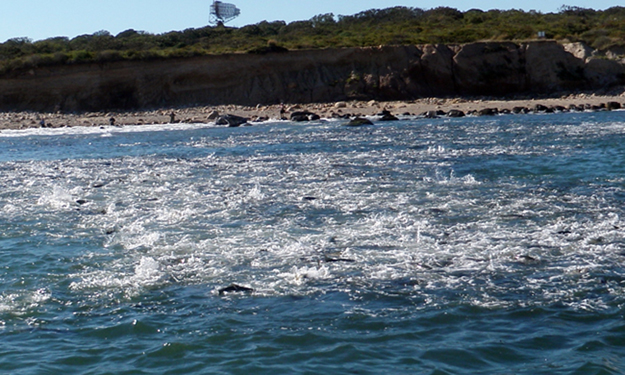
There is something familiar about the way striped bass season ends.
Fish are on the move, and the North Fork is but a pit stop. The signs are similar to the beginning of the season, with birds and bait signifying the presence of striped bass. But the fish are heading south instead of north this time around, and with them goes another season of striped bass fishing.
During the striped bass’s spring migration, each arriving body of fish brings the promise of more. More fish, longer days, warmer water, and months of fishing still ahead. The fall migration carries a much different feeling. You might enjoy catching the fish just as much, but somewhere in the back of your mind, you know the end is close.
The challenge for anglers like myself is that migrating fish rarely make promises, especially in the fall. Once they recognize it’s time to head south, they waste no time. The stripers you see blitzing on Trumans Beach one day may be well west of Montauk Point by the next tide cycle. A cold spell in the late fall moves fish faster than any other time of year. The rapidly cooling water tells the fish that their time in our local waters has come to an end.
That uncertainty is part of what makes November fishing so compelling. As the trees grow barren and winter begins to settle over the East End, any striped bass you release could be your last of the season. Of course, that’s also a good reason to make another cast.
North Fork and Shelter Island surfcaster Capt. Arek Zenel-Walasek shares that reluctance to put the rods away. “The morning lows might be dipping into the 30s, but the fishing is far from over for the surfcaster,” he said. Reflecting on an uneven fall, including the absence of the albies he had hoped to find, Capt. Arek warns not to put the rods away too soon. He said that while most of our prized gamefish have or will soon vacate local waters, there are still fish to be caught.
To capitalize on the closing stages of the fishery, he suggests anglers shift their expectations and approach. “Every November, schools of small stripers work their way along Long Island Sound’s North Shore, often hugging the beach in less than a foot of water,” he said.
The last migratory stripers we see on the East End don’t always favor an angler onboard a boat. It’s often land-based anglers that get the best shots at these fish. Capt. Arek notes that late-season opportunities do not always announce themselves with acres of blitzing bass, either. He recommends focusing on places where current gathers bait. Large rocky points and boulder fields along the North Fork are where he’s had most of his late season success. Birds can also offer clues, even when their activity falls short of the spectacle anglers tend to look for.
“Even one or two diving cormorants could indicate bait being pushed toward the surface by feeding bass,” according to Capt. Arek.
At any other point in the year, most anglers would overlook something that subtle. The fall trains anglers to scan for any surface feeds. Most other days, it’s clear when fish are set up in an area. Flocks of birds, breaking fish, and seas of anglers flood the beaches for most of September and October, but November is different. November rewards a willingness to look.
Capt. Arek’s final recommendation is straightforward: “Fish low and slow.”
A small bucktail or swim shad worked near the bottom can reach fish that show little interest in chasing a lure across the surface. A topwater plug may have helped locate aggressive bass earlier in the season, but now a slower presentation deserves a chance.
“Just because you don’t see bass chasing bait on the surface doesn’t mean they aren’t there,” Captain Arek advises.
There is something fitting about slowing down as the season comes to a close. After months of picking and choosing conditions wisely, the end of the season forces us to embrace whatever conditions Mother Nature provides. In a way, it simplifies things. You’re not waiting until the conditions perfectly line up or to hear where your buddy is catching fish; you’re fishing whenever you can, no matter the reports. All that’s keeping your rod from collecting dust is the hope that some fish have lingered.
A few years ago, I managed to sneak away from my family before Thanksgiving dinner and picked away at schoolies on a North Fork beach until the turkey was ready. None of those fish were big, but that hardly mattered. It was late November, and I was still catching striped bass.
For that afternoon, at least, the season wasn’t over.
That is the opportunity still in front of us. While the best of the tautog and seabass fishing is still to come, the best of the striper action is now well behind us. The fishing may slow, and the remaining chances may become harder to predict, but it’s important to remember that slowing down does not mean it is over.
In spring, we head to the beach hoping the first bass has arrived. In fall, we return hoping the last one has not yet left.