View from the Bridge: The sailing experience
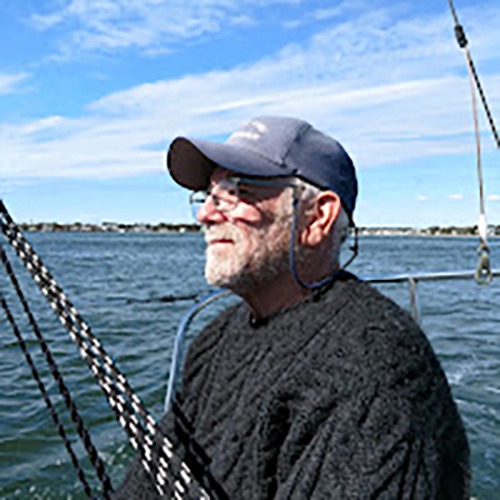
Jonathan Russo’s Afloat column in the July 9 Reporter brought back a flood of memories from another era of boating, and sailing in particular.
Jonathan has a wonderful way of writing about life on the water, and this installment centered on the Shelter Island Yacht Club’s Heatherton Trophy Race. Accompanying the column was Nigel Francombe’s striking photograph of Ghost, one of the Division1 boats, driving downwind under a cloud of sail.
I was introduced to sailing through an ethic that had little to do with winning races and everything to do with understanding a boat and its relationship with the wind that powered it. For that I owe an enormous debt to my sailing instructor, Louie Delasala, who spent four summers teaching me, beginning when I was nine years old.
I still own the thoroughly dog-eared copy of Royce’s Sailing Illustrated (Second Edition); Louie’s unquestioned bible. Tucked neatly between its worn pages remains one of his typewritten instruction sheets. It has survived countless moves and decades of life because it represents much more than a lesson plan.
Sailing with Louie was never a leisurely afternoon sail. It was a constant drill. One moment he would ask, “Where’s the clew?” The next, “What does the downhaul accomplish?” Before I’d finished answering, he’d bark, “Ready about!” or “Prepare to jibe!” He insisted that every sailor understand not only what each line and fitting was called, but why it existed and how it affected the boat. Looking back, I realized he wasn’t simply teaching children to sail. He was teaching us to think.
I’ve mainly been a smaller boat sailor. That’s not to diminish the pleasure of a well-found 40-foot yacht, but I’ve long subscribed to the philosophy that less boat is often more boat. Smaller boats cost less to buy, less to maintain, less to insure, and less to operate, and they are easy to single hand. More importantly, they keep the sailor intimately connected to the water, the wind, and the boat itself. There is little room for complacency in a small boat.
Perhaps that’s because every small boat I sail takes me back to Northwest Harbor in 1959, sitting on the weather rail of a Woodpussy with my little hands gripping the tiller while Louie patiently explained what the wind was trying to tell me, and then shifted to drill instructor mode.
Maybe that’s what boating was always meant to be for me.
Over the years I’ve sailed everything from little dinghies to catamarans exceeding 40 feet, and every one offered their own rewards. Yet one of my favorite routines was arriving in a quiet harbor, dropping the hook, launching the sailing dinghy, and exploring places the larger boat couldn’t reach.
My own sailing dinghy was a Dyer knock-off named Frodo. She towed beautifully behind the mother ship and sailed even better. At one point she suffered what might politely be called an unfortunate encounter with a marina forklift. The tines skewered her hull, leaving me convinced she was destined for the scrap heap. Instead, she returned from the repair shop looking better than she had before the accident. Like many good boats, she had character before and after her mishap.
None of this is meant to suggest that racing has no place in sailing. Quite the contrary. Racing sharpens boat handling, encourages innovation, and rewards preparation and teamwork. I have participated in a handful of races myself. One remains especially memorable because our crew abandoned the competition altogether to assist another sailboat that had caught fire. At that moment, trophies became irrelevant. Seamanship and helping fellow mariners mattered far more.
Still, racing has never been my primary attraction.
Nigel Francombe’s photograph of Ghost illustrates a type of sailboat that has become common today: Jeppesen design, plumb bow, long waterline, open transom, twin helm stations, bulb keel, spade rudder, flattened underbody, towering triple spreader rig; polar plots guide sailing strategy. Every feature reflects the pursuit of speed and performance. Boats often say as much about their owners as houses or automobiles, and Ghost speaks of competition and a desire to go fast and win.
My own boats have spoken a different language.
Whether sailboats or my Pacific Northwest pilothouse cruiser, they have reflected an appreciation for classic design, practical engineering, and seaworthiness. Many were designed or strongly influenced by naval architects such as Carl Alberg, Sam Crocker, and Ed Monk. None would ever threaten the leaders in the Heatherton Trophy Race, nor were they intended to. They were honest boats, built to look after their crews and bring them safely home when conditions became less than friendly.
Growing up in a New York City cooperative apartment building, I was extraordinarily fortunate to have neighbors named Paul and Jean, a childless couple whose generosity influenced my life. They owned two Allied sailboats over the years, first a Seawind and later a Mistress. Paul happened to be an engineer, and weekends spent aboard their boats became an education extending far beyond sailing. Watching him solve mechanical problems, maintain systems, and approach every challenge with quiet logic undoubtedly influenced my own engineering career as much as it improved my seamanship.
When Paul’s work transferred him to Los Angeles, the Mistress made the journey as well, eventually finding her home in Marina del Rey. That move unexpectedly introduced me to Pacific waters and a very different style of sailing. Long before she left the East Coast, I was fortunate enough to help deliver the Mistress from the Allied facility in Catskill, N.Y. to East Hampton — a voyage that remains among my favorite memories afloat.
Looking back now, I realize the boats themselves were only part of the story. The greater gifts were the people who patiently shared their knowledge and their time. They taught me that sailing isn’t measured in trophies or corrected time. It is measured in judgment, confidence, curiosity, and respect for the sea. Those lessons stayed with me far longer than any finish line or trophy ever could. .