Aging with dignity and happiness: Reporter Forum draws big crowd discussing senior issues
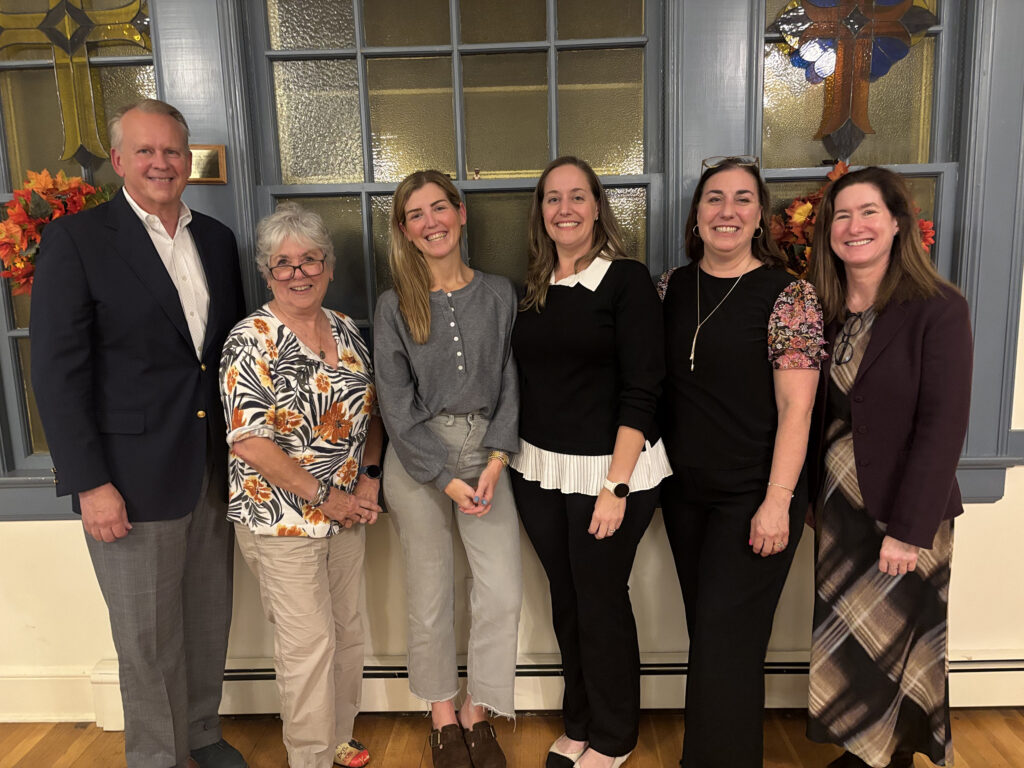
Residents packed the Presbyterian Church’s Fellowship Hall on Thursday, Oct. 1, for the latest Reporter Community Forum to hear a distinguished panel discuss the challenges of aging on Shelter Island.
The forum, one in a series the Reporter has brought to the community, was sponsored by Suffolk Security Systems; Sandra V. Saiegh, Attorney at Law; Mattituck Environmental Services; and Jernick Moving and Storage.
Moderator Charity Robey posed questions to the panel, which later took questions and comments from the audience. Among the topics touched on was a looming crisis in the scarcity home health care workers; moving the senior Center to a better location; how to safely age in place; the importance of nutrition; and how many chiropractors it takes to screw in a light bulb. (Answer to come.)
Ms. Robey opened her remarks with some statistics: “According to the census, the median age of Shelter Islanders i is 20 percent higher than Suffolk County as a whole, and 25 percent higher than New York State. The average Shelter Islander is a senior, and for those on the younger end of seniorhood, there is plenty to plan for if we want to stay here.”
She noted that there’s currently no full-time doctor on Shelter Island; the pharmacy has closed; there is no public transportation; one grocery store; and affordable dining options are scarce and indoor recreation is limited.
The Town’s Senior Center Director Kelly Brochu was introduced by Ms. Robey, saying that Ms. Brochu had spent the day overseeing the vaccination “of everyone and their uncle,” a reference to the free vaccination clinic at the Center that day, just one of the many events sponsored under Ms. Brochu’s leadership.

She took Ms. Robey’s assessment of the Island’s limitations and countered by listing the many programs the Center provides, including free rides for medical appointments, service to off-Island pharmacies, shopping, and entertainment options. At the Center there’s an extensive recreation schedule and an outreach to seniors in their homes, Ms. Brochu said, to check on their well-being and provide them with a social connection, which all panelists agreed is an essential part of growing older with dignity and happiness.
Another member of the panel, Senior Center Director of Nutrition Emily Needham, spoke about the hearty and nutritious meals the Center provides free of charge for home delivery and in-person at Fellowship Hall. The meals provided is also, Ms. Needham said, another way for the elderly to connect with one another and people of different ages, which eases the pain of isolation.
Let the Sunshine In
Councilwoman Meg Larsen, who is the Town Board’s deputy supervisor and the Board’s liaison to the Health & Wellness Committee, brought some news about the state of the Senior Center located on the lower level of the Medical Center on South Ferry Road. “We’re going to move the Senior Center out of the basement … somewhere with sunlight, windows and a yard,” Ms. Larsen said.

She said the Town had engaged an engineering firm “to do a facilities master plan” to analyze all municipal buildings, including “their structural integrity, the amount of space we have available, and how it’s being used.” This will allow policy makers “to figure out how to either reuse our spaces, modify them so that they work better for everybody, or develop a new space that works better for everybody,” and a priority is finding a better location for the Senior Center.
It’s not just the Senior Center, Ms. Larsen noted, but almost all of the town-owned buildings are in sorry shape. One example, she said, is that when it rains, it also rains inside Town Hall.
The problem has been, she added, that many of the buildings were donated, such as the Medical Center. “Or they’re buildings that we’ve purchased and re-purposed, which is not always the most efficient. It’s going to be a process, and it’s going to take time to really develop a solid plan and make sure that it’s something that you’re on board with.” Seeking Aid
Ms. Larsen touched on the shortage of home health aides for Island seniors who have been recently discharged from hospitals or have chronic conditions. Part of the problem is the scarcity of home health aides in Suffolk County and the expense of commuting to the Island. Another reason, voiced later in the program by audience member Jim Colligan, a former Town councilman and currently co-chair of the Health & Wellness Committee, is that many of the aides are immigrants who have been arrested by ICE agents, or have been intimidated by raids from working publicly. To politicians who have supported ICE agents randomly detaining immigrants in widespread sweeps, Mr. Colligan said, “How dare you?”
Ms. Larsen said that affordable housing on the Island could cure this ill, especially with accessory dwelling units, where a property owner converts a garage, an outbuilding, or an attic into livable apartments.
She also spoke of an idea of starting “a new medical practice that would just be focused on home care.” It would be Medicare, Medicaid, Medicare advantage and insurance-based. “The program will work in coordination with your doctors, with your hospital … we have already started reaching out and speaking to Northwell, speaking to Stony Brooke, and some of the other doctor’s offices in the area, just to see if they be willing to partner with us in this,” Ms. Larsen said.
Good Signs
The health of Island seniors has improved dramatically recently, said Dr. Alison C. Madden, MD, Chief Medical Officer at Stony Brook Eastern Long Island Hospital. ELIH has recently been designated as a “Primary Stroke Center” after more than two years of work to meet national standards The certification by the Joint Commission, an independent nonprofit that accredits and evaluates healthcare organizations for quality and safety, is particularly important for Shelter Island with a population at higher risk for stroke. Primary Stroke Centers are certified based on their ability to provide rapid diagnosis and treatment, including around-the-clock access to imaging, lab services and coordinated care protocols.

If someone feels they’re having stroke, or a person with them thinks so, the Island’s Emergency Medical Services can transport the person to ELIH, notifying the hospital staff that they’re on their way.
President of the Shelter Island Senior Citizens Foundation and Reporter columnist Joanne Sherman mentioned that many people don’t realize that if there is a medical emergency in the middle of the night outside ferry schedules, a boat is always ready at any time to transport patients. When EMS volunteers diagnose that the patient needs transport, a call goes out and a ferry crew on standby has a boat ready when the ambulance arrives at the dock
After EMS notifies the hospital staff that they’re their way, Dr. Madden said, “That means we get our CT scan ready, we have the team ready, the doctor comes wherever they are, and we’re ready. And when someone comes in, we can bring them very quickly back and get a CP scanner. Since we become a Primary Stroke Center, we’ve almost doubled our volume of patients coming.”
With strokes, time is the critical factor for care: the faster the patient can be treated the greater the chance of a full recovery, the doctor said.
We’re Here
Ms. Sherman spoke about the foundation starting out as a Town committee but then becoming a nonprofit. Working with Town government and the Senior Center, the foundation has financed new vehicles taking seniors to appointments, shopping and entertainment. The Foundation has made major upgrades to Fellowship Hall’s kitchen where meals are prepared and improvements at the library project for a space dedicated to seniors.
Just one of the many programs making life better for seniors is the Foundation’s partnership with the Fire Department to provide free smoke detectors and installation to anyone on the Island over the age of 60. It was also mentioned that the Town has a free home repair program for seniors, who only have to foot the bill for materials.
Ms. Sherman spoke about the need for donations and summed up the work of the Foundation: “We want to make you safer. We want you to hang around for a while, and to enjoy your time. We’re here for each other.”
Interesting times
So, how many chiropractors does it take to screw in a light bulb? “One,” said Chiropractor Dr. James Hinsch, who has patients in Mattituck and Shelter Island. “But it takes 12 visits.”
Entertaining and engaging, the doctor said his specialty is “the least understood healthcare practice in the world … What chiropractors do is analyze the spine, and look for misalignments, and then, if you’re young enough, they can correct them. If you’re a senior, it’s generally a process of managing them … I have a confession. I’ve been in practice 38 years. I have never healed anyone of anything. Patients heal themselves.”
He spoke about the need for exercise, for avoiding non-processed food and the importance of sleep. “There’s a lot of stuff that goes on neurologically, digestively, hormonally, when you get the proper amount of sleep,” Dr. Hinsch said. “So, if you’re going to bed at various times at night, if you’re not sleeping in a dark enough room, if you’re not sleeping in a cool enough room, if your mattress is a traditional spring mattress, and it’s more than 10 years old, you’ve got to fix that. If you rent a place, and it came with a bed, get rid of it.”
Attitude and clear mindedness is also essential for a healthy old age, he added, and quoted the old curse: May you live interesting times. “Best to turn off the news. And just read the Reporter,” he said.