Senior Center hosts students seeking stories: Telling youngsters what it was like long ago
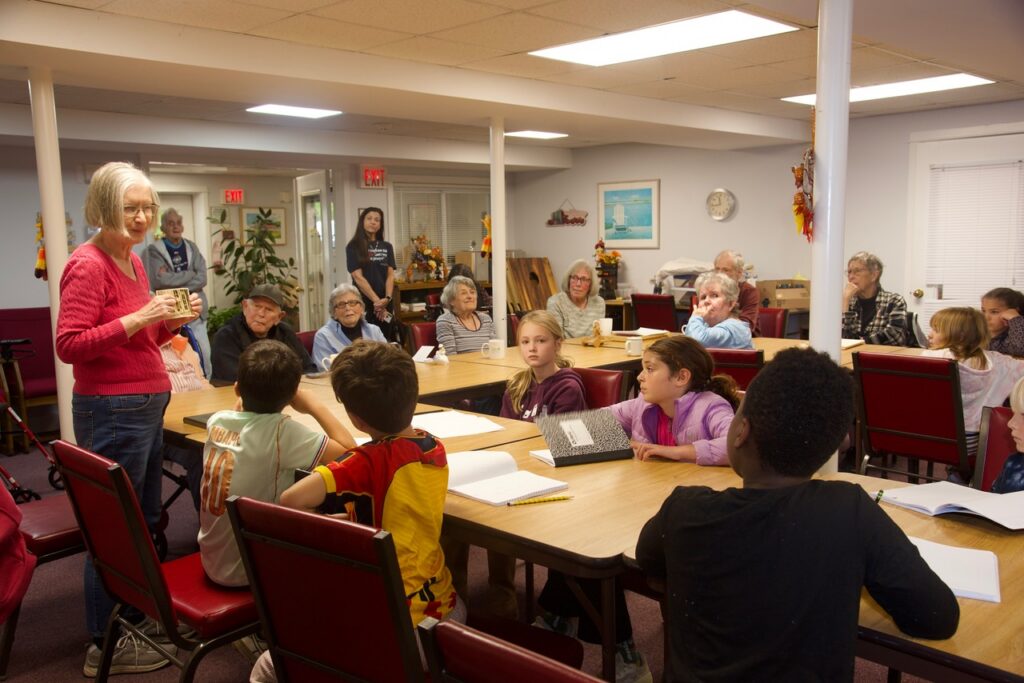
On the morning of Thursday, Nov. 5, an equal number of Island seniors and school children 8-to-10 years old, were gathered around long tables positioned in a U-shape in the center of the Shelter Island Senior Center’s community room. The students from the Hayground School in Bridgehampton were looking for stories, and Island seniors, armed with fascinating artifacts from their pasts, had stories to tell.
The project was developed by Julie Fanelli, an instructor at Hayground School, a co-educational private school, established in 1996. ““My class has focused on solving problems by envisioning, designing and building prototypes for inventions that solve a specific problem they’ve identified,” Ms. Fanelli said. “My inspiration came from growing up in a close relationship with my grandfather who built the first prototype for the fiberglass ladder. I’ve always wanted to create a curriculum around the stories that led to inventions, because I heard my grandfather tell his story, which involved falling off a roof because his wooden ladder broke. The story inspired me, connected me to a different generation, taught me about history, and what humans are capable of creating … also, I believe that growing old can be a lonely and isolating experience … but hearing their stories and seeing the artifacts that are so important to them is hands on history.”
In cooperation with the Center’s Director Kelly Brochu, Center Community Liaison Laurie Fanelli, and a group of Island seniors happy to participate, Ms. Fanelli and fellow teacher Travis Foreman arranged to bring their students here on a story-finding mission.
Island resident Jane Aterno was the first to share. Her grandfather, a carpenter from Germany, had handed down a $20 gold piece he had received in payment for his services at the turn of the last century. Ms. Aterno’s husband, Vincent, then displayed an old game from 1907 called Mench Harger (“Don’t get mad”), that was the forerunner of the modern board game, Sorry.
Senior Karen Kiaer was next. She told how her great-great grandfather from Michigan had fought under General Ulysses S. Grant in the Civil War and kept a diary, which she then showed the students. One of Grant’s entries told of hearing about President Lincoln’s assassination in April 1865.
Bettianne Morritt showed the students wooden toys her husband, Tom, had made — an intricate small house and a robot with movable legs and arms. Tom had been a school teacher and master woodworker who often spoke at Boy Scouts meetings and at Boys Clubs about his craft. Emily Hallmann, who had always desired to become a registered nurse, told of how society at that time encouraged young women to marry and have families instead of a career. So, she did marry and had four children but later divorced, took part-time jobs to support herself and her children, and also managed to become a registered nurse after all. Times had changed.
Next, Andra MacDonald had brought her mother’s high school yearbook from 1929. She pointed out how fashions had changed, from hem lengths to hair-dos. She also noted that her mother had spoken about when there were no preventions or cures for certain terrible diseases like tuberculosis and polio. She’d told her daughter that every fall, when she returned to school, at least one or two classmates were missing. Andra also suggested that everyone ask their parents and grandparents as many questions as possible now. There are questions she meant to ask, but didn’t and now there’s nobody to answer them.
Laurie Fanelli then shared a beautiful, framed photograph from the 1950’s of two ocean liners from the United States Lines, the America and the United States. Her husband had worked on the latter, which is now scheduled to be de-commissioned, deliberately sunk and made into a reef in the Gulf of Mexico.
Bob Springsteen shared a picture of little houses that were lit and displayed at his grandparents’ house on Long Island every Thanksgiving, and now have come to grace his home at the holidays.
As a final contribution, Vincent Abrami asked the students how they take photos—on their phones, of course. He then unpacked his camera from back in the day, a Nikon with all manner of lenses and attachments. “See, I would’ve missed the shot with all this to deal with,” he said, smiling.
The story-hunters had been mesmerized and pizza lunch broke the spell. Seniors and students created an ad hoc “balloon game” that was played by all after lunch, followed by Ms. Brochu serving cookies from a treasured platter that had belonged to her grandmother.
Apparently, another senior/student reunion is being planned. “Our experience today will lead us to authentic investigation of many historic events the Civil War, Stock Market crash, steam ships, celestial navigation, ”Ms. Brochu said. “This is a way for their curiosity to be stoked, and for a passion for story, history and intergenerational experiences to be nurtured.”