Bringing back an essential natural resource
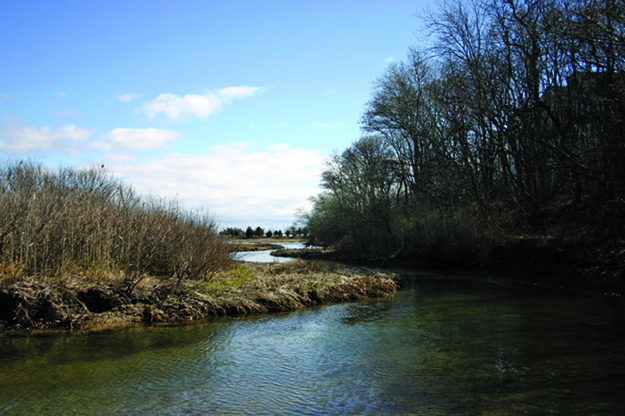
The Nature Conservancy held a special program at the Mashomack Visitors Center on April 17. The Conservancy’s Senior Coastal Scientist Nicole Maher, took a deep dive into the history of the human impact on our local coastal marshes.
Ms. Maher presented an overview of some of the history of salt marsh farming on Shelter Island. Much of the land on the Island, including the salt marshes, were a vital source of farming for several hundred years, growing a variety of crops that tolerated, and perhaps flourished, in our salt marshes.

Salt hay was a principle crop grown and used for many purposes, including feeding livestock during the winter months, insulating ice during the late spring and summer, making paper binders and fancy ladies’ hats, and bench seats in Ford trucks, just to mention a few. There’s evidence that barley, sugar beets, sorghum, wild rice and other food plant sources also flourished in salt marshes.
This almost-forgotten history of salt marshes on the Island, as well as up and down the East Coast, had been documented during the 18th and 19th centuries by photographers and painters. Ms. Maher displayed some of these paintings which clearly show how farmers utilized these salt marshes for their benefit.
She explained how many of our salt marshes have deteriorated, due to farmers’ attempts to control the hydrology of the marshes, utilizing techniques such as ditching and creating embankments, as well as other adaptations. Once salt marsh farming was no longer utilized, the marshes lost their natural ability to control their hydrology with the changing tides. Obviously, climate change and sea rise have also contributed to the deterioration of this invaluable natural resource.
But why should we be concerned about the health of our salt marshes? Because salt marshes are vital coastal ecosystems providing immense environmental benefits, acting as “nurseries of the sea” for over 75% of commercial fish and shellfish species.
They act as natural buffers, reducing erosion and absorbing wave energy from storms. These marshes also helped in water quality improvement, acting as “earth’s kidneys” by trapping sediments and filtering pollutants, such as heavy metals and excess nutrients from fertilizer runoff, preventing harmful algal blooms in coastal waters.
Salt marshes also aid in climate change mitigation and are incredibly efficient carbon sinks, trapping carbon in their soils at a rate of up to 10 times higher than tropical forests, thus helping to reduce greenhouse gases.
Finally, these marshes also support biodiversity, hosting a vast range of species and providing essential habitat for migratory waterfowl, wading birds, and various juvenile fish and crustacean species.
Now that art and science have opened our eyes, we can use this information to understand why our marshes are deteriorating in the ways and design light touch restoration approaches.
SMARTeams, or data management systems, have been diagnosing hydrological impairments and taking new approaches to restore growing conditions and switch elevation trajectories from negative to positive. Ditch remediation and the use of runnels to relieve waterlogged subsidence and facilitate plant growth have proven to be successful.
The salt marsh sparrows are the “canary in the coal mine” for these teams. Success for these sparrows represents a level of resilience for all that we expect our coast marshes to do for people and nature.