The Persistence of Memory: A son remembers and honors his veteran father
On Memorial Day we mourn and pay tribute to the men and women who gave their lives while serving in the U.S. Armed Forces. In the 14th century, when the word “memorial” was first used, it meant “remembered, committed to memory.” It’s a tragedy that my father spent nearly 50 years of his life desperately trying not to remember his wartime experience.
In addition to the 173 U.S. military cemeteries in the U.S. and others across the globe, there are also countless graves of soldiers who served and were fortunate to return to civilian life. My father, William Andersen Robbins, was such a man. In 1993 he was laid to rest right here on Shelter Island.
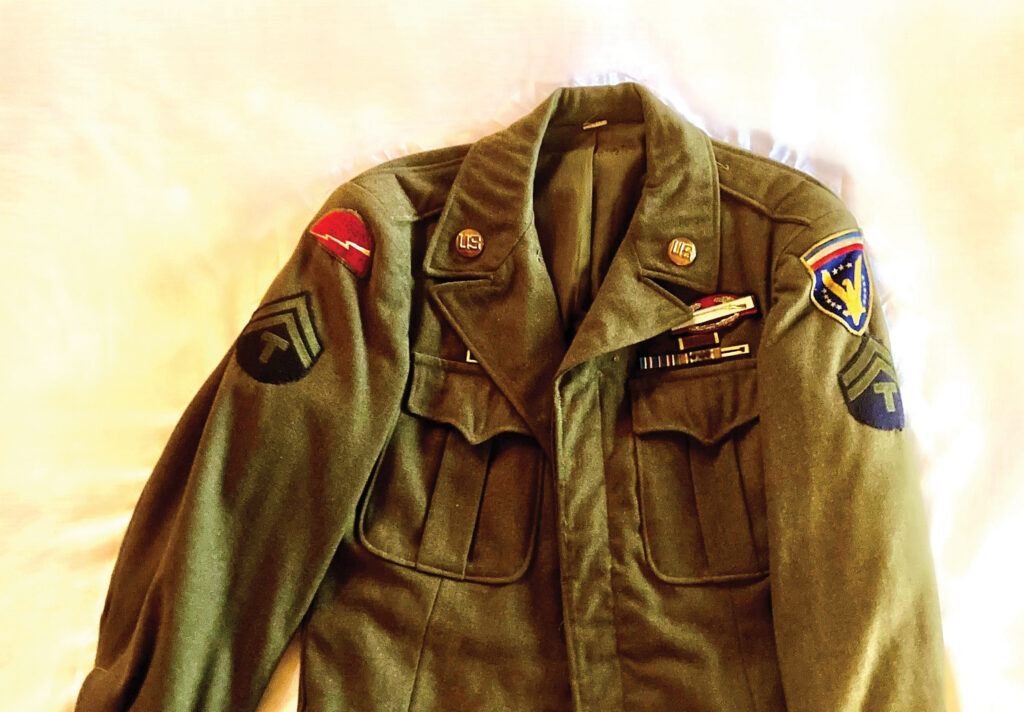
He was drafted in 1943 at age 18 after having spent one semester at Hamilton College. He achieved the rank of Corporal, Fifth Grade Technician in the U.S. Army’s 78th (Lightning) Infantry Division. He arrived in France on the 22nd of November — 169 days after D-Day—just as the European continent embarked on one of the coldest winters ever recorded.

On the 7th of December, the 78th was engaged in the Battle of the Bulge, part of an Allied contingent totaling more than 700,000 men. It was the bloodiest single battle fought by the U.S. in WW II with an estimated 19,000 U.S. soldiers perishing within a six-week period. The Allies’ victory at the Battle of the Bulge ultimately forced the Germans to withdraw eastward, eventually crossing the Rhine River. As they retreated over the Rhine, it became strategically imperative for the Germans to destroy all its bridges in order to hinder the Allies as they pursued them further into German territory.
In early March 1945 U.S. commanders were flabbergasted when they learned that the Ludendorff Bridge at Remagen was the last intact — albeit damaged — bridge over the Rhine, especially since the retreating Germans made numerous failed attempts to destroy it with explosives, myriad artillery, floating mines, and V-2 rockets, among other armaments. The bridge finally collapsed on March 17, but not before approximately 125,000 troops, including my father, had crossed the Rhine.

Unlike 20,000 American soldiers, my father survived both the Bulge and the Bridge at Remagen battles, advancing farther east until he experienced what he later described as “the happiest day in my life.” The exact date was April 13, 1945, the day my father was wounded, his inner right thigh sliced by shrapnel (note that if his wound had been four inches north you wouldn’t be reading this). He was transported from the front back to liberated Paris, where he convalesced.
My father was one of those veterans who rarely spoke of his wartime experience. When I was a kid, I was curious but never dared to ask, and what little he shared came in pained fragments. He once recalled digging foxholes in frozen earth and stuffing military-issue socks into jars of kerosene for warmth, awakening as he choked on ash-laden mucus. He spoke, only once, of standing next to a buddy and witnessing his head blown to smithereens. He had recurring nightmares, bolting upright in bed shouting, “I’m freezing! I’m freezing!” as my mother held him and tried to warm him up.
Much later it became clear that he wasn’t re-experiencing one of Europe’s coldest winters. What truly haunted him was the fear of frozen hesitation, that face-to-face with a Nazi, he might not pull the trigger first.
Nonetheless, right after the war ended my father returned to college as a 20-year-old second semester freshman. He told two stories of his post-war college experience. He talked of laughing at the professor who admonished the returning veterans for smoking in class.
“I just got back from fighting the Nazis and I’m gonna smoke wherever the [expletive] I care to,” was the pointed response.
He also joined a venerable WASP-y fraternity and tried to get his good friend Myron Beldock admitted. He was explicitly rejected because he was Jewish. My father quit the fraternity the next day.
“Why the hell did I fight in the war if not to make sure [expletive] like this was a thing of the past?”
Somehow he earned his bachelor’s degree in three years with a tri-major of English/French/Psychology and was elected Phi Beta Kappa. He went to graduate school at Columbia.
After the war, he suffered from debilitating mental health issues for the remaining 48 years of his life. I have no doubt they were rooted in what he endured. Post-Traumatic Stress Disorder (PTSD) had not yet become a recognized diagnosis; that wouldn’t happen until 1980, so he had no name for what afflicted him. But it was there, locked inside him, for the rest of his life.
William Andersen Robbins was an exceptionally bright, emotional, loving man. He married, helped raise two kids, had a successful career as a magazine editor, and in 1966 bought his pride and joy: a beautiful property on Shelter Island. But throughout he struggled mightily with debilitating depression and anxiety, which ultimately was his downfall.
Psychologists now know that traumatic memory is fundamentally different from ordinary memory in that it does not soften with time but remains raw and immediate. My father needed to forget and could not.
This is my memorial to him. Not to the man compromised by his memories, but to the whole man within — who lived as best he could.