Crossings: A ferry captain looks back
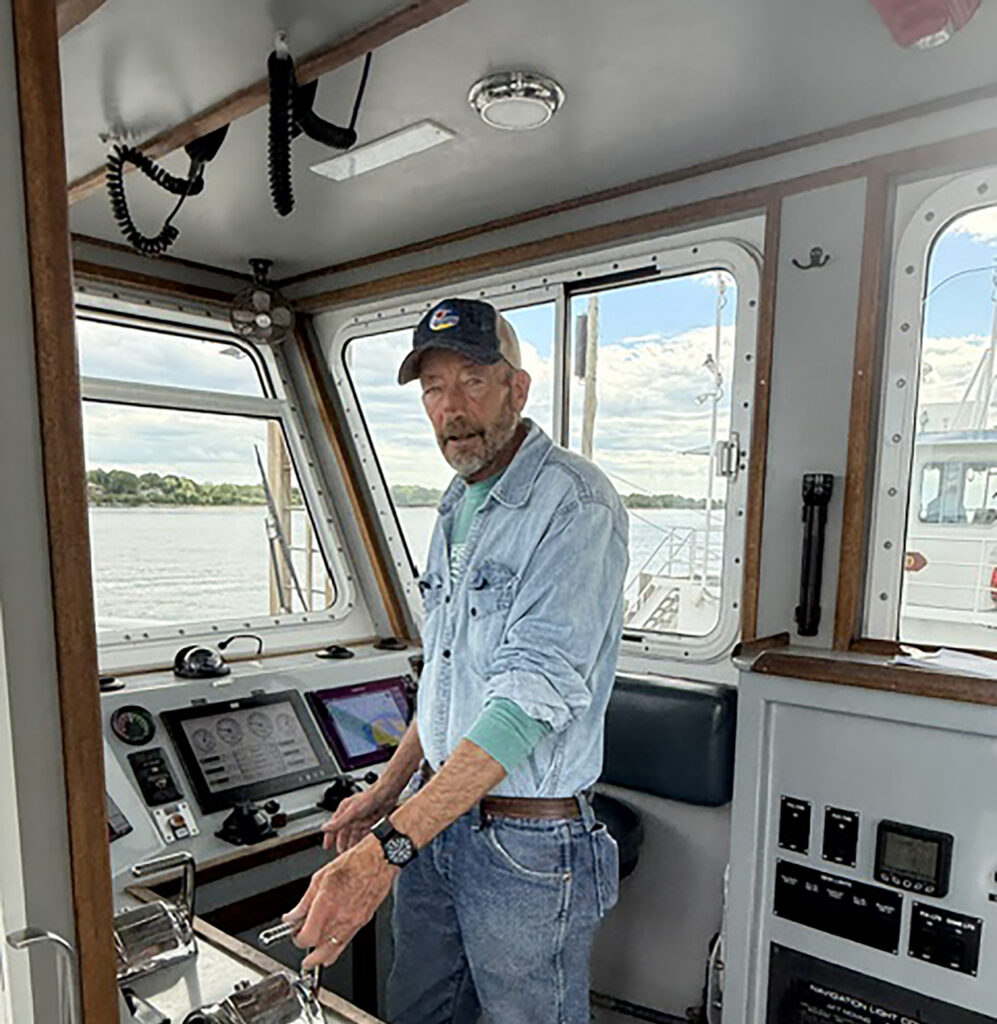
“It was my playground,” said Captain Jon Westervelt, recalling with a typical mixture of humor and understatement his early years starting at 18 on the decks of South Ferry boats. “I was just a kid.”
At that age, on June 1, 1978, Captain Westervelt signed on, and a year later was a captain, the youngest in the ferry company’s recent history. This June, after 48 years, he’s retiring.
During that 50-year run he’s made remarkable, at times close-to-perilous crossings, between Shelter Island and North Haven; captained a boat for a legendary rescue mission during a harrowing storm to get an Islander safely to a hospital; and as Senior Training Officer for South Ferry trained and mentored 16 novices to achieve their captain’s license, including at least six women skippers — “There were none when I started” — with his stepdaughter Captain Katie Iacono and most recently Captain Amelia Clark, a 7th generation Clark family member, among those he trained.
“He’s the ultimate senior instructor — patient, incredibly knowledgeable, and always leading by example,” said Cliff Clark, South Ferry co-owner and CEO.
Fulfilling a Legacy
Salt water and boats are part of his heritage. His father was a New Jersey-based tugboat captain and ship-docking pilot who, his son remembered, when he first came to Shelter Island said, “This is better,” and took a job with North Ferry in 1977.
While playing golf with Tink Clark, an owner of South Ferry at that time, the elder Westervelt received an offer for a job for his son as a deckhand on the ferry. When Jon graduated from Shelter Island High School he was on the job.

The Merchant Marine rules are that to make captain, you must have worked on a boat for at least one year. “Working six days a week, doing nine-hour shifts — for peanuts — I earned my captain’s license in 1979,” he said. Throughout his decades with the company, Capitan Westervlt said he always counted his blessings, fortunate to work for a family business “made up of good people.”
He remembered those who helped a raw youngster learn the ropes — literally and figuratively — including Ed Cartwright, Glen Waddington, Jason Green and Jack Clark. Cliff Clark was a prized mentor, not much older than the young Jon. “He was a tall skinny kid who could run like the wind,” he remembered, referring to Mr. Clark’s storied college running career. He was also a cool customer as a trainer.
When Jon took the helm on his first day running a boat by himself, Cliff was on deck, and then sat in the cabin and read a newspaper. As they disembarked, Captain Westervelt recalled with a smile, he said, “Call me if you need me.”
Letting him know he was on his own except for an emergency was a lesson the captain learned and used in his own training of would-be captains. It’s a serious business, he noted, teaching the techniques of learning the tides, how to run into the wind and navigate through a channel strewn with thick ice.

“When I’m training someone, I wait until the very last minter before stepping in” if the trainee is having trouble, he said. “They learn much more, and much quicker if they solve the problems themselves.”
Rescue
Captain Westervelt was in charge in October 2012 for one of the most legendary rescue operations in Island history, when Superstorm Sandy, a wide-ranging and deadly nor’easter, with gusts in excess of 90 mph, struck the Island with full force.
At the height of the storm, in the early afternoon, all Island first responders — ambulance EMTs, Fire and Police department personnel — came to the aid of Virginia Jernick, 93. She was at home in the Center experiencing respiratory distress that rapidly escalated into a life-threatening situation. After police, EMTs, Ms. Jernick and her family had all conferred, they agreed to take her from her home by ambulance to Southampton Hospital.
Cliff Clark said, “I picked Jon to captain the boat for a critical medical evacuation. That tells you everything you need to know about his skill. It was a life-or-death situation and Jon was the captain I wanted at the helm. There are simply no captains more skilled at operating these vessels than Captain Westervelt.”
Firefighters, responding to South Ferry to help with the emergency, could see that the road in front of the ferry slips was flooded to a height of three feet. Another problem was the loading ramp, which was pitched at a 45-degree angle up to the boat deck because of the storm tide. It was clear the ambulance couldn’t get through the water or, even if it could, drive onto the deck without getting hung up.
First responders noticed David Lingwood, an employee at Coecle’s Harbor Marina at the time, waiting to board the ferry in his four-wheel-drive diesel Ford pickup, who readily agreed to help. The decision was made to transfer the elderly patient from the town ambulance to the bed of the Good Samaritan’s high-riding vehicle for the ferry crossing.
Weight would be important for ballast to keep the truck from slipping off course in the wind and tide, but a solution was soon reached. Firefighters and EMS personnel — including 90-year-old Ben Jones — got in the back with the patient, adding over 1,000 pounds for ballast. The elderly woman was carried under a tarp and transferred to Mr. Lingwood’s vehicle.

In the wheel house with Captain Westervelt was the late Captain Nicholas Morehead, who was assigned to keep an eye out for floating debris, especially the remains of docks that had been torn apart by the storm. On deck was the company’s owner himself, Mr. Clark.
Ready to cross, the situation was treacherous, with shrieking winds and water so high the pilings of the bulkhead were nearly crested. Captain Westervelt was steady and sure-handed, working a perfect crossing — aided by Chief Engineer Phil Dunne, Foreman Joey Clark — and docking at North Haven. The last part of the journey might have been the hairiest, looking for a dock to bring the boat into since others were underwater or damaged.
Grace under pressure and leadership from the captain prevailed. A Sag Harbor ambulance met the ferry at North Haven and Ms. Jernick and family members were taken without incident to Southampton.
Changes
In nearly 50 years with South Ferry, Captain Westervelt has seen enormous changes. “We had old boats when I started, old, but well maintained,” he said, and now the boats are bigger and computerized — “We call it flying-by-wire” — a significant shift away from the use of hydraulics and cables. “It’s all electric and really efficient. Much more user friendly, much more easier to run than the old days.”
The other great change is one of numbers. More people, more travelers, more boats. Currently, the company operates five active vessels that transport approximately 750,000 vehicles and 1,250,000 passengers annually between North Haven/Sag Harbor and Shelter Island.
Legacy
Cliff Clark summed up what he described as the end of an era for South Ferry: “Patient, incredibly knowledgeable, and always leading by example, Captain Westervelt represents the very best of our community. He always went out of his way to help passengers, making everyone feel safe and welcome on board. From earning his Merchant Mariner’s license as a teenager to steering through the treacherous winds of Hurricane Sandy to save a life, Captain Jon Westervelt’s 48-year career at South Ferry is defined by unparalleled skill and quiet heroism.”

What does a captain do when he leaves the wheelhouse? This captain is looking forward to spending more time with his wife Joannne and family, traveling, and also tending to real estate interests he has in Florida.
But he’s not through with salt water and boats. “I told Clifford I’m ready for anything he needs,” Captain Westervelt said.