U.S. Open bid brings Goat Hill history to Dallas: Islanders Card and Hannabury team up on the course
It’s known as the “Longest Day in Golf.” Eighteen holes, a brief lunch, then another 18 holes — a grueling walk that often takes more than 10 hours. So why do thousands of amateurs and professionals across the country sign up to play in these tournaments?
Simply put, the prize: A chance to play in the U.S. Open. This year, Shinnecock Hills in Southampton will host the event.
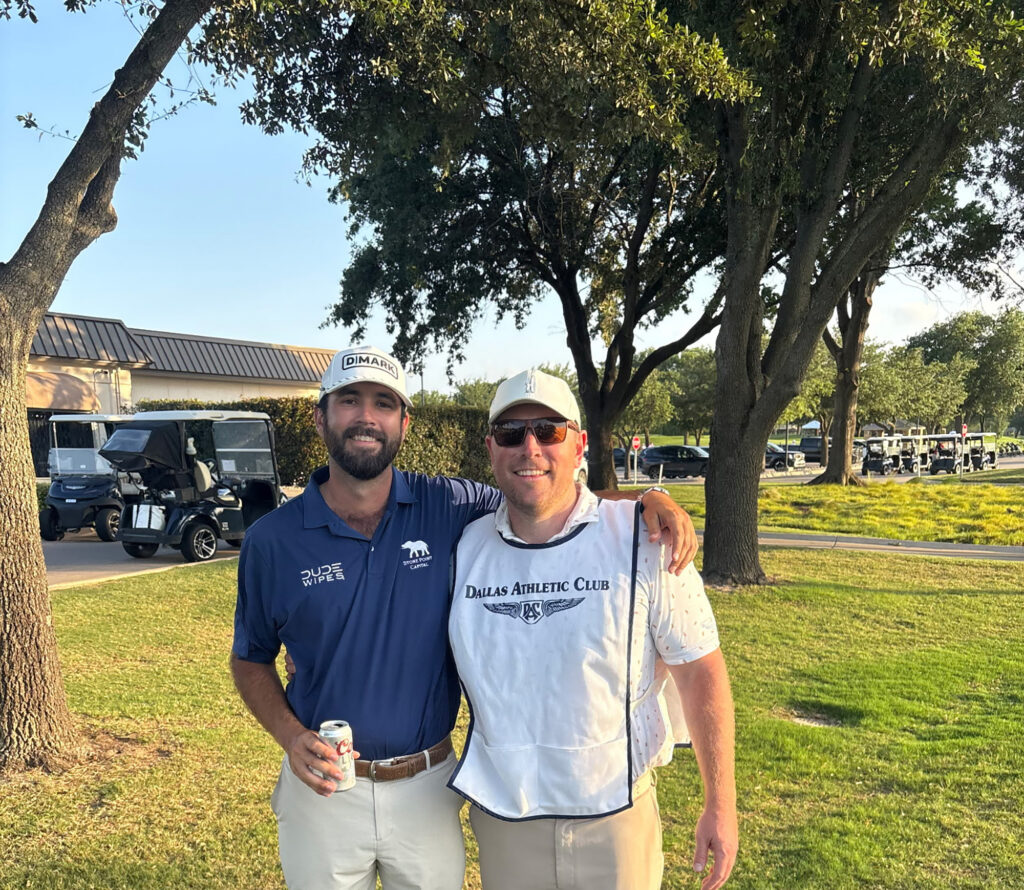
Just a few weeks ago at the Dallas Athletic Club in Texas, players like Sergio Garcia, Tom Kim and Patrick Reed were all fighting for a spot. In that same field was Shelter Island’s own Jay “Jake” Card III. Jake missed qualifying by four shots, shooting a 36-hole total of 143, 1 over par. But it was not the close call that made the round so special for him. It was his caddie.
On the bag for Jake that day was Shane Hannabury, who grew up around Shelter Island golf and learned to play the game at the Shelter Island Country Club, better known as Goat Hill. Shane is also the great-grandson of two of Goat Hill’s most important stewards.
Following the qualifier, the Reporter spoke with Shane over the phone to discuss what it was like spending time on the course with Card.
Aside from Shane’s storied history with Goat Hill, he also recalls endless rounds with Jake’s father, Jay Card II. Jay was a police officer who served alongside Shane’s father, Bill Hannabury. “I remember as a kid playing golf with Big Jay,” Shane said. “Jake was probably barely born. So it’s kind of fun to see that come full circle. It’s like our families have just sort of done parallel paths for a while.”
Shane now lives in Dallas, but still spends his summers back on the East End. A few years ago, Jake was passing through Texas for a tournament and reached out. Shane took him out to his home club, Dallas Athletic Club, and the two played golf together. Since then, they’ve kept in touch.
Like many, Shane has been watching from home as Jake has made impressive strides in his professional career. Jake currently competes on the Korn Ferry Tour, one step below the PGA Tour. “The whole experience was obviously really cool,” Shane said. “It was cool to be on his bag, and then you look at the field and see big name guys walking around.”
That’s not to say Jake was out of the running, because Shane said he absolutely was right there. “I’m caddying for Jake, and we’re not spectators,” Shane said. “He’s every bit good enough. It’s a hard thing to qualify for, but he absolutely is good enough to do it.”
Looking back, it was never really a question if or when Shane would be introduced to the game of golf, since Goat Hill is deeply rooted in his family’s history. For context, from the 1940s through the 1970s, Bill and Olive Congdon ran Goat Hill before it eventually made its way into the hands of the Town of Shelter Island in 1978, where it still remains today. Shane said he was fortunate enough to have them in his life through his early years.
“My great-grandmother used to run the pro shop and the snack bar, and then my great-grandfather would kind of do everything from giving lessons to mowing the fairways and maintaining the grounds,” he said. “So for decades and decades, they ran everything up there.” That history is still visible inside the clubhouse. “Still to this day, if you go in, it says ‘Bill and Olive’s Clubhouse,’” Shane said. “Those are my great-grandparents. So it’s kind of a neat nod to their history.”
Today, Goat Hill is run by a nonprofit made up of volunteers, and in many ways, that same culture of people stepping up still defines the place. It’s not a course built around prestige, but around the people who keep the place going. Shane said that’s something he still notices, especially now living in Dallas.
“Living in a bigger city and playing golf in a bigger city, in that kind of bigger club, you probably lose a sense of community and seeing a lot of familiar faces all the time,” Shane said. That, he said, is what makes Shelter Island different. “It’s definitely a Shelter Island thing where people step up and help out however they can,” he added. “I absolutely miss that part.”
And in a way, caddying for Jake became another way for Shane to stay connected to that culture. Leading up to the qualifier, people texted and called. Some knew he was caddying, some knew Jake was playing at his club, and others were simply excited to follow along.
“There were people I hadn’t spoken to since maybe last summer, even a couple of years, that I reconnected with because they were excited about what was going on,” Shane said. “That was really cool.”
That may be the best way to explain what Shelter Island golf is about. Goat Hill’s history has never been only about the course itself, but the people who keep showing up for it. And in Dallas, in his own way, Shane did too. “Being on the bag of a guy like that, who you know and have some history with,” he said, “was just a really special day.”