Gone Fishing: How nor’easters reshape the fall fishery

No weather event marks the transition from summer to fall in the Northeast quite like the season’s first nor’easter.
As I write this, one of these powerful coastal storms is expected to develop along the East Coast before dissipating offshore. Days of gale-force wind, rain and deteriorating marine conditions are expected on the East End.
For fishermen, however, the effects of a nor’easter extend well beyond the days spent tied to the dock. These storms can bring one fishery to an abrupt end, but also spark the start of another.
Migratory fish will typically “set up” in an area while on the move. This is when a fish, like the striped bass, finds an area with preferable conditions on its way south (or north if in spring) and stays in that area for as long as conditions stay relatively similar. Baitfish is one of the main reasons for migrating fish to take a pit stop. If a bass has the opportunity to consistently feed and fatten up before winter, it will take it. When those favorable conditions change gradually, the fish may slowly adjust. A nor’easter can change all of that in a matter of hours.
That sudden change can be especially important for the striped bass fishery around the Peconics, Shelter Island and the North Fork. The late summer and early fall can be a slow period for striped bass locally. Water temperatures often remain close to their summer levels, leaving the stripers in our area lethargic and unwilling to waste much energy feeding even as more bait begins to appear. Much of the biomass of bass is still farther east, and the fishing in our local waters is nowhere close to where it will be in a few weeks’ time.
The period before a nor’easter can break that pattern. Leading up to a weather event like this one, the barometric pressure quickly drops. Not only do anglers know this by checking the weather app on their phones, but fish feel it too. Whether the fish are reacting to the change in pressure itself or to the accompanying shifts in wind, current and forage, the pattern is familiar: fish often feed heavily before conditions deteriorate. Once the storm arrives, visibility, smell and other hunting conditions diminish for species like the striped bass. They somehow anticipate this before an impending storm, and take advantage of the conditions before they decline.
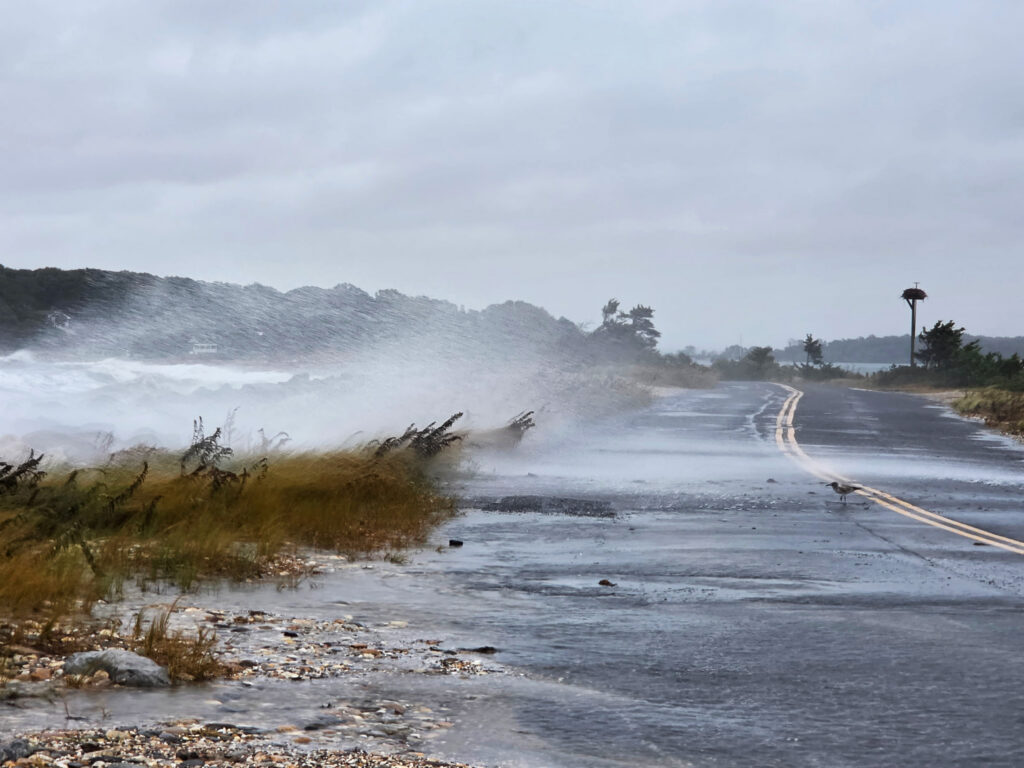
There is nothing pleasant about the storm itself. Strong northeast winds have a long stretch of open water over which to build. The result can be dangerous surf and truly treacherous seas. Even in the more protected bays, persistent wind can build steep chop, muddy the water and make boating unsafe. No possible bite is worth testing those conditions.
It is the aftermath that creates anticipation. A strong fall storm disrupts patterns of the fisheries here on the East End, altering temperatures, reducing water clarity and pushing bait fish away from places they had been holding in.
Predatory fish respond by moving. Not only is their food no longer available, their senses are worsened by the amount of sediment kicked up in the water. With no real visibility or sense of direction, the striped bass could end up anywhere across a stretch of many miles.
Given that the winds are expected to come in from the northeast, chances are that the fish will be pushed toward the west. An area that held bass for weeks could suddenly go quiet, while an area that held nothing worth fishing could come alive.
A nor’easter does not simply make the fish disappear; it reorganizes the fishery. Baitfish can be pushed miles from the area they were originally in, and their predators won’t be far behind. Fish that had settled locally may be displaced, while another group migrating from farther east may move into the newly changed water. This is how a storm can help turn a quiet early fall into the beginning of a true fall run.
I expect both sides of that change to affect our local fishing conditions. The false albacore currently set up in Gardiners Bay and around Montauk may be scattered or pushed elsewhere. At the same time, the storm could help move a new body of striped bass, albies, or bonito westward into areas that are currently seeing nothing but cocktail bluefish. The same nor’easter that kills one angler’s bite can create another angler’s best fishing of the season.
Exactly what will happen is impossible to predict. The fishery could look completely different once the wind settles. A body of stripers could move in, creating an opportunity for anglers to get their first ones of the fall, or we could lose a week to un-fishable conditions only to find that little has changed.
Still, history on the water tells us that these storms rarely pass without leaving some mark. Only when anglers return to the fishing grounds will we know what effect the fall’s first storm has had.