Hunting mushrooms after dark at Mashomack: Fluorescent wonders are revealed
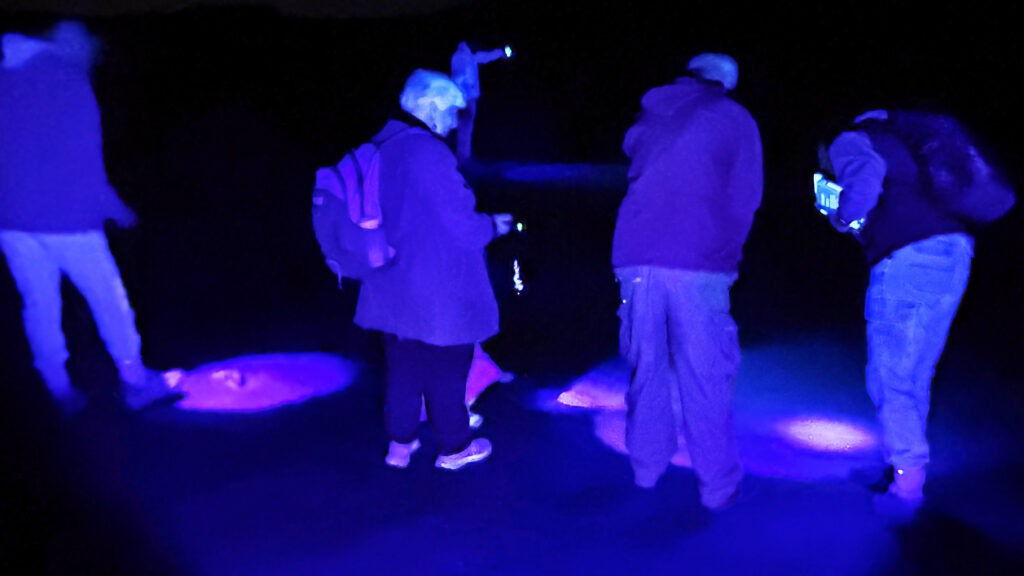
After a nor’easter postponed Mashomack Preserve’s inaugural Fluorescent Fungi hike, the search for the glowing fungi took place on Friday, Oct. 9.
Participants were handed UV flashlights and pamphlets, briefed on the different types of fungi they could encounter, and then guided on a one-and-a-half-hour hike along trails within the preserve.
Biofluorescent mushrooms absorb ultraviolet light and emit visible light, whereas bioluminescent mushrooms produce their own light through chemical reactions. The event focused on biofluorescent fungi, as participants of all ages shone their flashlights along the trails and into the brush, looking for anything that glowed.
What are fungi? They’re neither plant nor animal, but separate things, called heterotrophs, which instead of making their own food like plants through photosyntheses, absorb nutrition from living or dead organic matter.
The event attracted participants of all ages, including one nature enthusiast who was just 5 years old. “I love when people, no matter what age, are excited about nature, respect it, and want to learn about it,” said Christina Larson, the Conservation and Volunteer Coordinator at Mashomack Preserve, before the hike began. Ms. Larson led the fungi hike and came up with the idea earlier this year.
“It really makes me happy, and I’m happy to share my knowledge with anyone who is curious,” Ms. Larson added. She explained that, “I’m not a mycologist [a scientist who studies fungi], just an enthusiast. Whenever I’m out hiking the trails, doing trail work or managing invasive species, whenever I see a mushroom, I have to stop and look at it. While I was creating one of my ‘Environmental Explorers’ programs, I thought, ‘How fun would it be if we went out in the woods with UV flashlights and tried to see what was out there?’ Then I realized, ‘Oh my gosh! Mushrooms actually biofluoresce under UV light.’ I thought that was really cool and exciting, and it’s something that’s not done very often.”
According to BBC Earth, scientists have found that fungi cells “are surprisingly similar to human cells. It’s estimated that fungi split from animals about 1.538 billion years ago — 9 million years later than plants did.” Mushrooms have been used for centuries as food, as hallucinogens in religious ceremonies and as medicine. BBC Earth notes: “Around 4,500 B.C., the Greek physician Hippocrates classified the as a potent anti-inflammatory. And the first peoples of North America used — and still use — puffball mushrooms to heal their wounds. Whilst there is little scientific evidence to support the medicinal benefits of mushrooms, they’ve featured in traditional Chinese medicine for centuries.”
The hike began at the Manor House, then continued toward Bass Creek and eventually looped back. Along the way, the group identified numerous fluorescent objects. “On the front lawn, we saw a couple of different kinds of amanitas,” Ms. Larson said. “We knew they were amanitas because they had a knobbed cap with some scales on top, which is a key characteristic of amanitas.”
Farther along the hike, objects such as a small piece of rope, certain leaves, and a group of vines caught the group’s attention as they glowed under the UV light, as did some aquatic life along the edge of Bass Creek.
“Down by the beach and kayak area, we saw russulas. They had depressed caps, meaning the caps curve inward,” Ms. Larson added.
The event concluded shortly after 8 p.m., as participants made their way back to their cars to drive out of the Preserve. Mashomack Preserve, operated by The Nature Conservancy, hosts a wide range of events throughout the year, and the fungi hike was just one of many offered this autumn.
Two annual staples are fast approaching: the Fall Foliage Truck Tour on Saturday, Oct. 24, from 10 a.m. to 12:30 p.m., and Nature’s Halloween Trail on Friday, Oct. 30, from 5:30 to 7 p.m. Additional opportunities to get involved include Stewardship Saturday on Oct. 17, from 10 a.m. to noon, and Native Seed Collection on Sunday, Nov. 1, from 10 a.m. to noon. Visit the Mashomack Preserve website to learn more about upcoming events and register.