A home that has turned visitors into residents for 150 years: A history of friendship and love in the Heights
On an island with a lot of great houses, 4 Summerfield Place, just up the hill from the North Ferry, is the one that launched a thousand summers.
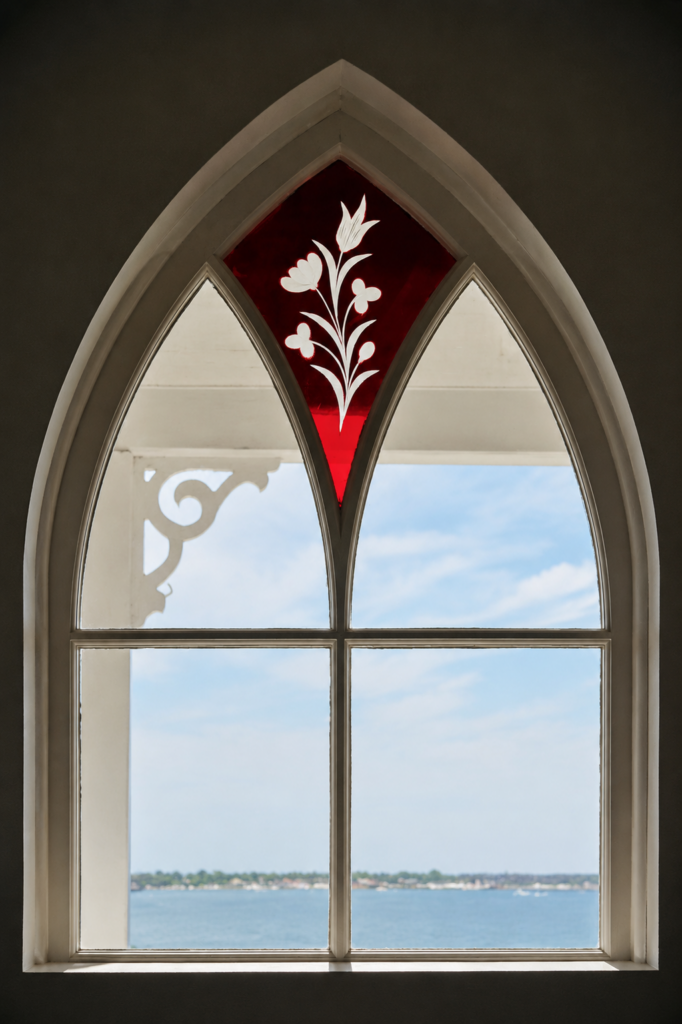
A Victorian Gothic cottage with a commanding view of Greenport Harbor, it was built in 1873 by John French, president of the Shelter Island Grove & Camp Meeting Association, one of three summer cottages he built. A 1915 map of the Heights identifies it as belonging to the Estate of Mary B. French.
The Summerfield Place house was a place to summer before summer was a verb; a cross-shaped wooden structure, painted Nantucket Red, with windows on all sides, and views of every ferry, yacht, sailboat, kayak and paddleboarder that has plied the waters between Shelter Island and Greenport for 150 years. The mandate to relax and recreate was so established that 4 Summerfield Place, and the other cottages built in the Heights, did not have kitchens until around 1900, when octagonal kitchens were added onto the three cottages with a hallway connecting each to the rest of the house to guard against spreading fires.

She Came From Arkansas
The current owner is George de Man, who lives in Atlanta and visits for a month after Labor Day every year. The house has been his family’s summer home since his mother, Josephine Thompson, purchased it for $7,000 in 1956. Mrs. Thompson grew up in Helena, Ark., a historic Mississippi River port town, and came to Shelter Island as a child when her mother decided after seeing an ad in The New York Times that a suitable summer camp for her daughter would be Dr. Pettit’s Camp for Girls. That connection to Shelter Island formed a lifetime bond, and Mrs. Thompson owned the house until her death in 1994.
George de Man spent summers in the house as a child, a tradition he continued with his own family. He sold advertising from his Atlanta-based Southern Territory for The New Yorker. Trips to New York several times a year on business gave him additional opportunities to spend time in the house with his wife and sons. He loved to sail, and his gardening acumen can still be seen in the landscape of flowers and trees around the house.
During those years, Mr. de Man and his wife filled the house with the work of local artists, furniture from yard sales, and found objects, most of which are still in use in the house today. “We found a back window from a Volkswagen Bug, which we inverted and used as a Danish Modern-style cheese-serving tray,” he said.
Summer Renters
In his mother’s later years, Mr. de Man said they began renting out the house for part of the summer between Memorial Day and Labor Day, keeping September and October for themselves. In 1981, Lois B. Morris and a group of friends (many of whom worked at health and fitness publications like Self and Glamour) had been renting in Bridgehampton. They started looking on Shelter Island when they came from the South Fork to run the Shelter Island 10K and liked the pace of life they found here. Of that group of original renters, Ms. Morris, who went on to buy a house on the Island, considers herself “the primogenitor of the red house rental.” In her first summer at 4 Summerfield, Ms. Morris drew the short straw on bedroom assignments and got a tiny room downstairs near the kitchen, which she referred to as “the scullery.”
She and her friends rode their bikes to the ocean beach in Bridgehampton (unaware that Shelter Island had beaches), cooked meals together, worked on jigsaw puzzles and watched the world sail by from the porch and the picture windows facing the bay. One of the people who shared the house with Ms. Morris brought her child, a boy who would ride in a bike seat all the way to the beach in Bridgehampton and is now 51 years old.
Eventually, Ms. Morris discovered the Shelter Island beaches, and in 1984, fell for a house on West Neck Road and bought it with some money that her father left her. About the time she was making her home on West Neck Road, Kathy Heintzelman began renting the red house for the season. Since many of Ms. Heintzelman’s friends worked for the same New York-based magazines that she did, the house was full of people whose work involved watching celebrities, contemporary music and entertainment.
Among those renting during in the late 80s and early 90s was David Browne, a music reviewer for Entertainment Weekly and his wife, Maggie Murphy, who was also a rising journalist. “My boss at Entertainment Weekly used to call it the ‘Sleeping With the Enemy’ house,” Ms. Murphy said. “These days, if you knew all those people, you would be social media friends with them, and that’s how you’d find out what’s going on,” she said. “In those days, we found out what was going on in various parts of the publishing world in the house.”
Ms. Heintzelman bought her own house in the Heights after renting 4 Summerfield for 12 years. Ms. Murphy and Mr. Browne also spent summers at 4 Summerfield for many years, buying their own place in 2000.
Their time at 4 Summerfield had a real impact on their lives, and they left their mark on the house. “I think if you look hard, you can still probably find a few copies of Entertainment Weekly,” Mr. Browne said.
Saturday night dinner at the cottage’s bright yellow table was a focal point of the weekends, which were otherwise occupied with riding bikes to the beach and taking the ferry into Greenport for a movie or grocery run. Cars were rare; most renters came on the train or used the Sunrise bus service that predated the Hampton Jitney.
A Place Where Love Grows
In 1990, Jeff Baron, a playwright and author, joined the ranks of the summer renters at 4 Summerfield Place. The next spring he met Gary Carlisle singing in the New York City Gay Men’s Chorus. “We were kind of just getting to know each other,” said Mr. Baron, when he invited Mr. Carlisle, who was studying to be a nurse, to join him for a weekend at the house.
“You could swim off the back of that house,” Mr. Carlisle said. “No one had a boat. It was the kind of house where you automatically knew that it didn’t matter, the house was for summer.” They’ve been together ever since.
One summer, Mr. Baron’s mother came to 4 Summerfield to visit them. “She found it a little rustic,” he said. “You could never get it completely clean in the way that she liked. But we did really enjoy it. Now we have air conditioning, but then, no air conditioning.”
The Myth of Nelson
The open windows and dearth of insulation in 4 Summerfield Place and the neighboring cottages meant that music made on the porch of one, was enjoyed by all.
In the summer of 95, Nelson Bogart, a trumpet player who rented the house next door, stopped by to visit when Mr. Browne and some other music-obsessed weekenders were watching the 10th anniversary broadcast of Live Aid. They were crammed into the TV-watching nook on the main floor of the house, when according to Mr. Browne, Mr. Bogart casually mentioned that he was in the band behind Mick Jagger and Tina Turner at Live Aid. “And the next thing we know, there are Mick and Tina, on TV, doing their set, with a band behind them, and there’s Nelson on the trumpet.”
Nelson Bogart, who has serenaded the inhabitants of 4 Summerfield Place going back to George de Man, still entertains the Island community with performances on trumpet and guitar, most recently at the History Museum’s celebration of the 250th anniversary of the Founding.
Ms. Morris is not the only past resident of 4 Summerfield to feel a connection to the history of the Shelter Island. She said, “Yes, there is a sense of history. The flowering of summer life of Shelter Island, from when it was first settled, and you were part of history,” she said. “This is how people used to live, and it was extremely comfortable.”