The pleasure of fixing what’s broken: A community works together at the Repair Cafe
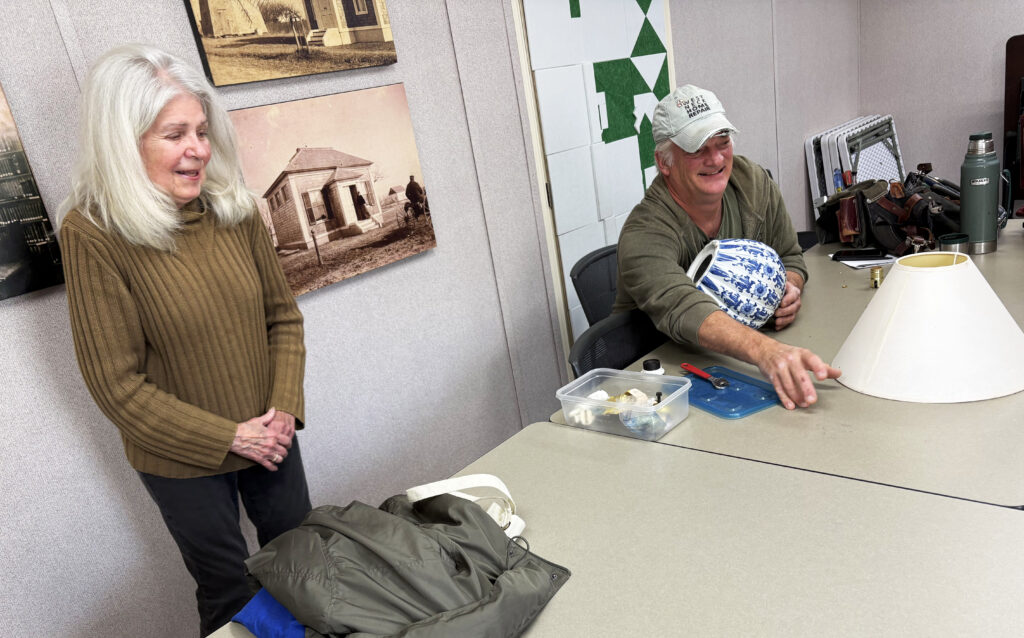
Lorraine Deller was in one of her favorite places. She was home in the living room sitting in a comfortable chair reading by the light of a treasured lamp she’s had for 20 years, the blue-and-white base shaped like a bowl
“Suddenly the lamp started flickering and then the switch popped off and flew across the room,” Ms. Deller said. “I really love the lamp and tried to fix it myself but couldn’t.”
So, she went immediately to Plan B and brought it to the library on Halloween morning to consult with experts at the Repair Café.
Four years ago, Kyle Karen, Ph.D., launched a Repair Café on Shelter Island, believing the ingredients for success here were natural factors to be tapped. Repair Café is a program that invites those with items that need to be repaired to bring them to those who know a thing or two about restoring them.
In some cases, the fixed items are returned to the owners, but others bring items they no longer want but recognize that in able hands they can be repaired and find new homes, rather than landing in the trash heap.
It’s not a program unique to Shelter Island, or even other East End communities, but one that was launched first in the Netherlands and has spread to areas around the world. There are now more than 4,000 of the DIY repair centers.
Before Ms. Deller arrived at the spacious meeting room in the library’s trailer, volunteers Greg Raymond, Pamela Pospisil and Mark Lindemann had gathered, along with Ms. Karen. They discussed separate concepts of the Repair Café, that it wasn’t just bringing stuff in and letting someone work on it, but it is “working together” and “reintroducing repair skills into the community,” Ms. Karen said, so residents can then pass those skills on and people can take pleasure in doing for themselves and not just tossing objects away. Ms. Karen also mentioned that the Island High School students can do their community service by attending the Café and working with the volunteers.
Anything and everything comes in for repair, they said, including all mechanical objects, furniture, electrical appliances, bicycles, crockery, jewelry and clothes — “Lots of purses,” Mr. Raymond said — as well as quilts and blankets. Beloved dolls who need surgery or maintenance also come across the worktable.
“Remember that little girl who came in and her doll had a broken arm?” Mr. Raymond said. “We fixed it and she left here just beaming.”
They spoke of the sad American trend of becoming a “throw-away society,” and noted that all blame shouldn’t go to those who don’t take care of everyday objects or know how to repair them, but that “planned obsolesce” built into goods is now everywhere, a corporate ploy to keep people replacing goods.
Ms. Pospisil said she had a GE refrigerator in her basement that was made in 1952 and still going strong, while Mr. Raymond said he was stunned that the battery in his truck had only lasted two years before giving up the ghost.
Ms. Pospisil grew up as child working with her father repairing everything from household items to outboard motors, which she still does, and Mr. Raymond, an electrician and all-around handy man, who can be found at West Neck Home Repair, recalled growing up in a large family and moving into a row house in Philadelphia where all of the Raymonds pitched in to renovate and redecorate.
Ms. Karen, who steadily did intricate needlework as she spoke, also came early to doing for herself, saying, “My mother was four-feet eleven and made almost all of her own clothes” so the little girl learned at her mother’s knee a practical, self-reliant way of living.
Mr. Lindmann was acknowledged by his Café colleagues as something of a mechanical genius through his work for IBM, repairing main frame computers.
When Ms. Deller showed up with the lamp, lampshade and parts of it in a plastic box, all of the volunteers got involved. But as Ms. Karen said, they encouraged Ms. Deller to get involved. As they all worked on the lamp, Elizabeth Nardin stopped by and asked, “Do you repair wicker?” She had some old and beloved outdoor furniture that had seen better days and had tried herself to make new but couldn’t.
The answer was unfortunately no, but Ms. Pospisil knew a place in North Sea that could do it. She found the information on her phone and give it to Ms. Nardin.
After about 20 minutes, with all volunteers offering advice, several different tools put to use, and Mr. Raymond going to his truck a couple of times, they handed the shade to Ms. Deller who screwed it on. She plugged the replaced cord into to the wall socket and soft, but bright light shone through the shade.
There was applause all around.
The volunteers were kept busy through the morning taking care of a sweater with a moth hole, a coat needing fixing and repairing a coffee maker, among other tasks.
Got broken stuff or anything that needs fixing? The next Repair Café will be at the library on Saturday, November 28, from 10 a.m. to noon.