A new Shelter Island vineyard begins to grow
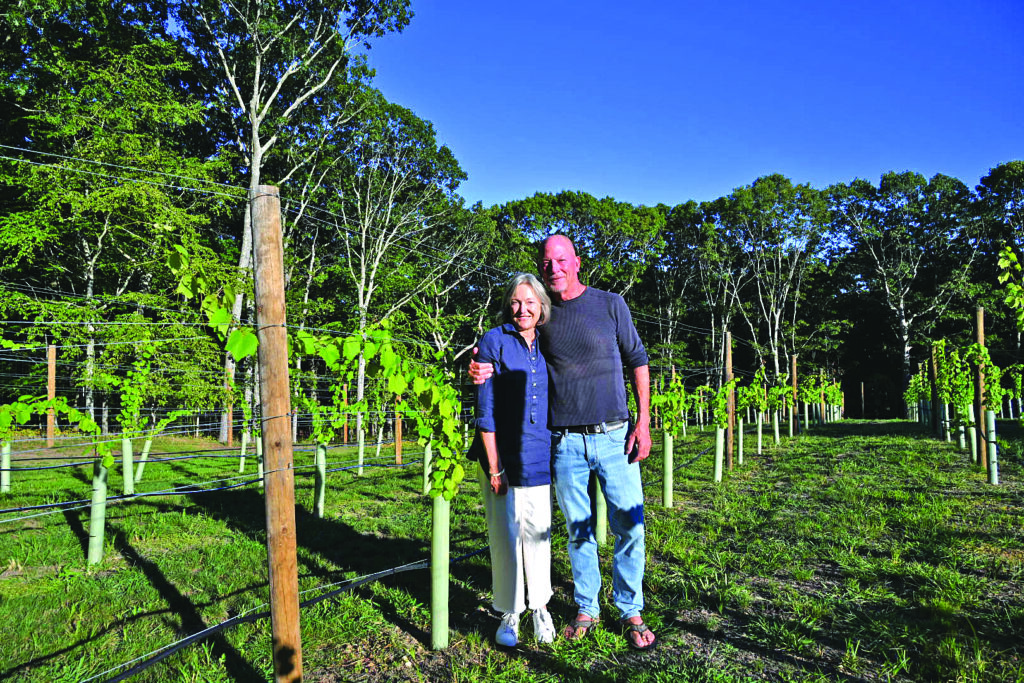
In September 2023, the Reporter ran a story on Joel Assouline, and his successful effort to establish a vineyard on the Island (“Shelter Island gets its first vineyard: fourth vintage on its way,” Sept. 9, 2023).
At the home his wife, architect Vibeke Lichten, had designed in the Heights, Mr. Assouline dedicated a gentle hillside to rows of grape plants and sought expert advice on turning them into wine. Reading that article, Sam and Karen Seymour were inspired to follow his example and reached out to seek guidance from Mr. Assouline, who was happy to mentor them.
Mr. Assouline’s wine production is mostly for his friends and family to enjoy, and he donates some to local Island nonprofits to include in the raffles and auctions at their fundraising events. Mostly producing rosé, his current vintage is a bright, refreshing taste of summer. He jokes about having “competition” from other winemakers, but in truth, he welcomes it: “I would love for the Island to have its own vineyards.”
The Seymours took a serious approach to developing a vineyard on their property, and consulted experts on the viability of doing so. “We needed to make sure we weren’t on a fool’s errand,” Karen Seymour said recently. Assured that it was possible, they ordered the plants and began clearing the land on their Stearns Point Road property.
Naturally, in a small community, the changes — removing trees, leveling the land — drew interest and speculation as to what might be going on the site. They took the rumors in stride. “Some said we were growing hops,” Ms. Seymour said, and they tried to ignore darker comments, expressed by “haters,” conjecting that a McMansion or other monstrous building was about to be erected.
Quite the contrary, rows of healthy, sturdy grapevines have appeared in the space, looking as if they’ve always been there.
The field now has 418 plants that have taken root and are thriving, and the Seymours indicated that they will patiently wait for the process of establishing the vineyard and eventually squeezing grapes to produce four types of wine. “Albariño, sauvignon blanc, merlot and petite bordeaux,” Mr. Seymour said.
While they wait for their first vintage some time in the future, the Seymours won’t have many idle hours. Over three decades, they’ve put down and nurtured their roots in the community. The couple have both been active volunteers in Island nonprofit organizations, even while pursuing busy careers in the law, from which they’ve recently retired.
Ms. Seymour has served as Chairman of the Mashomack Board and a member of the Perlman Music Program Board. Mr. Seymour has served on the Sylvester Manor Board.
“We’re also involved in aquaculture as well as agriculture,” he said.
They’ve been cultivating oysters in West Neck Bay this summer. Mr. Seymour has also embarked on his own “Pollock Project,” traversing hundreds of miles across the country to view Jackson Pollock paintings wherever they are on display.
They expressed gratitude to Joel Assouline for sharing his experience and guidance. For his part, he thanked Tom Spotteck, winemaker for Lenz and an Islander, and Gilles Martin, a French vintner who lives on the North Fork, for guiding his efforts.
Mr. Assouline’s first few years may serve as object lessons in the challenges of viniculture for the new winemakers, like warding off the mildew that has an affinity for vines, as well as deer, the bane of every Island gardener. In addition to raccoons and birds, this year he had to deal with Japanese beetles, which destroy the leaves. He traditionally has used only organic substances, but an expert advised him he had to spray to get rid of the beetles.
After losing a few plants in one of the first winters, Mr. Assouline babies them, placing stones around the roots to keep them warm.
“The vines go really deep,” he said, “to look for water, and that helps them to resist the temperature changes in the environment.” He said it takes about 10 years for them to be well established. He now has 11 rows of vines, with 256 plants, and he knows every one.
Recalling how pioneering efforts in the face of skepticism brought the first vineyards to the North Fork, he pointed out that the many North Fork wines that have emerged “are really doing well now, they’re well established.” He applauds the local farms that are keeping the agriculture tradition alive. “Sylvester Manor is doing a good job. There are very few farms left. It’s good to grow our own food — and our own wine. “
Mr Assouline is delighted that the Seymours have begun cultivating their vineyard. He said he’s heard of others who are planning to do so. “I would love to see Shelter Island able to sustain vineyards,” he added.
While patiently waiting for their vines to grow and mature in the Shelter Island soil and lift their grapes to the sun and salty breezes, the Seymours are enjoying the various suggestions they’ve been receiving for names for the vineyard and the wines it will ultimately produce. Possibly, a nod to the gentleman who hosted generations of Islanders at the historic Shelter Island House just down the road, Louis Behringer? Just steps away from the beach that Islanders still call by his name, its cozy restaurant in the shade of a grape arbor bore a name that might well befit a vineyard: “Louis’ Arbor.”