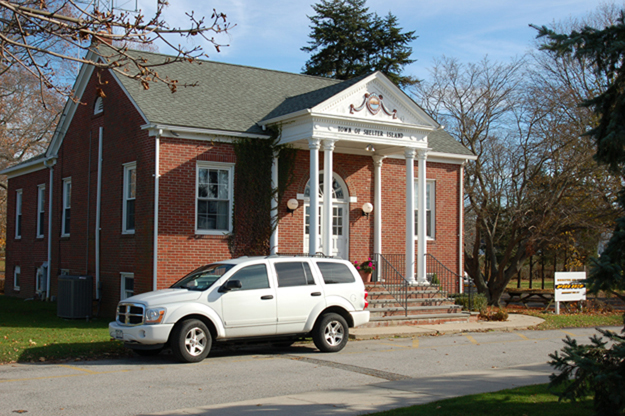
A discovery brings Shelter Island’s past to life
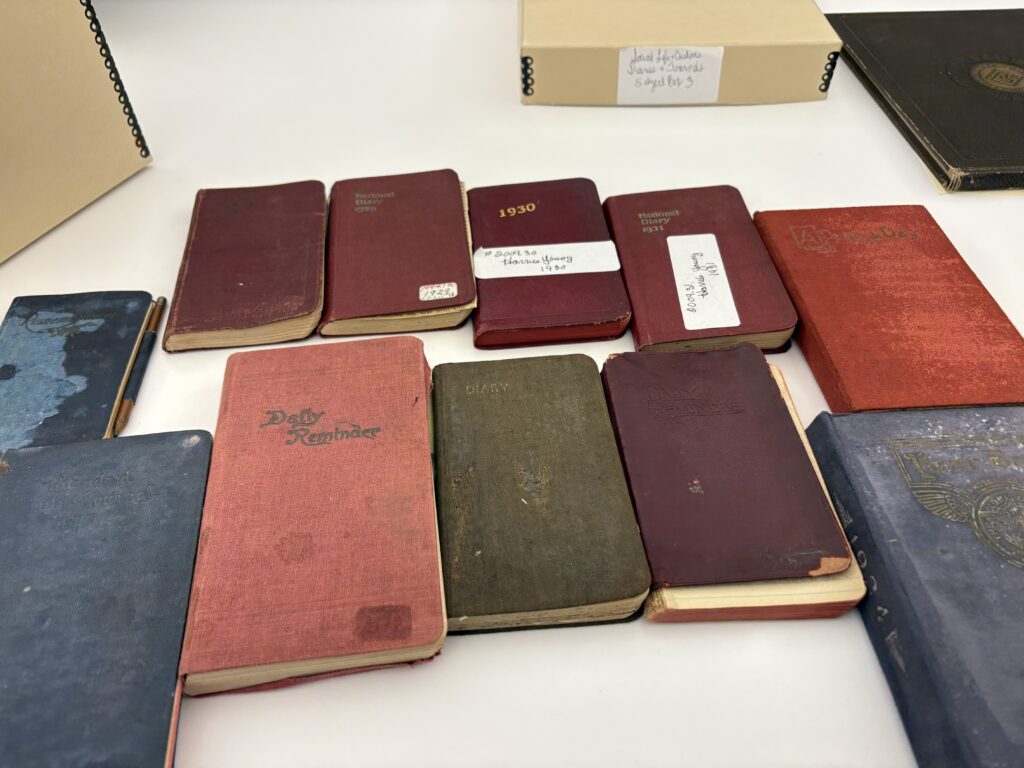
Working in the secure, spotless room called the vault at the Shelter Island History Museum, Michael McClain came upon a vivid, living presence.
Within an oblong cardboard box were 13 diaries written in small, age-weathered notebooks by an Islander named D. Harries Young Jr., recording his daily life in the first third of the 20th century. Mr. McClain, a volunteer who has been on the Museum’s board and served as its treasurer, has written that reading the diaries “is like peeping through a keyhole at the Shelter Island of a hundred years ago. They reveal a way of life viewed through the eyes of an intelligent and sensitive young man who saw a bit of the wider world but remained firmly rooted in what he called ‘this belle isle.’”
Harries’ diaries, from 1916 to 1936 (with gaps over the years), beginning when he was 9, gave Mr. McClain a living sense of an isolated island. Reading them, you understand what Mr. McClain means about that keyhole view, but also, as he said, how it’s impossible not to get close to a young man who loved life and lived with discipline as a primary virtue. “A person of strict habits,” Mr. McClain said.
The diaries were donated to the History Museum by Harries’ wife Virginia in 1994, two years after husband died. She died on Jan. 28, 1999, and is buried along with Harries in St. Mary’s cemetery. Asked about the diaries timeline, Mr. McClain said, “I don’t know if there were other diaries that we do not have, or if we have the complete set. The 1935 diary ends in October with no indication that Harries intended to end it then.”
A REMEMBRANCE OF THINGS PAST
The life of strict order appealed to Harries: recording the weather daily, going to the Heights for a newspaper, taking the ferry to Greenport to go to the movies, doing chores in the large garden every day, feeding the ducks and chickens, checking fishlines in Coecles Harbor, and recording his day every night before going to bed.
Growing up, Harries lived with his parents and older brother Tom in a house on Cartwright Road. His sister Helen and her husband Ernest lived across the street. Mr. McClain has written that, “Harries led a sheltered life, but it was filled with family, friends, and neighbors. His diary of 1917 contains a mention of 114 different people.”

At 16, he left for boarding school and then Wesleyan College in Connecticut. Here his love of reading accelerated; for the rest of his life he subscribed to “Limited Editions Club,” beautifully bound mail-ordered classics of the western canon, such as the Canterbury Tales, Shakespeare, Marlowe and philosophy.
He was a good student, and popular, becoming president of his residence hall, editor of the school’s yearbook and a player in student theatrics. Away at school, he received regular letters from his mother and spent summer and midterm vacations on Shelter Island. “While at home he gardened, did his chores, fished, and played golf,” Mr. McClain said. “In the spring of 1927, his father died unexpectedly, and he came home for the funeral. After graduating in 1931, he returned to Shelter Island and started to work with his brother Tom for the Shelter Island Light and Power Company, where he remained for most of his life.”
20th CENTURY LIFE MEETS 21st CENTURY TECH
Technology has given readers a magic portal to Island life from a century and more gone. As Mr. McClain noted, “The diaries are fragile and written in a cursive script that is sometimes difficult to decipher. To preserve their contents and make them available to a wider audience, we scanned the diaries to produce a PDF file for each year. We then used Google Gemini to transcribe the diaries into a standard Word format that is easier to read and edit. The transcriptions were approximately 95% accurate but required some editing.”

He added that Harries’ diaries refer to events, people and places that are obscure to contemporary readers, so they’ve been annotated using a ChatGPT program. “We also used a number of other resources to identify people, places, and events that are not available to online search engines,” Mr. McClain said. “These resources included maps, directories, letters, and diaries that are part of the History Museum archives, as well as genealogical records available through FamilySearch.org.”
The result is a stunning work of history.
It documents, as Mr. McClain has elegantly noted, “A time of significant change against a backdrop of routine daily life. The automobile replaced the horse and wagon. Electrical power spread throughout the Island, enabling the introduction of the radio and refrigerator. Indoor plumbing came into widespread use and talkies replaced silent films at the Greenport Metro. But even as these innovations were taking hold, Harries … carried on the time-honored traditions of walking to school, hanging out laundry, cultivating the family garden, playing board games with neighbors, and visiting nearby relatives and friends.”
BOY TO MAN
The diaries, from the start, reveal a driven, disciplined boy attempting to get life on the page, with little or no punctuation to get it down rapidly before sleep, but a boy with a sense of humor:
Saturday, April 8, 1916. Hailed and snowed in the afternoon east winds I was over to Helens to dinner and spent the afternoon I made a bird house got it partly finished. Tom came home with Pop stayed all night he played pool with me. Mt Lassen the only volcano of US is in California it is like one that is sick — keeps throwing up.
Mr. McClain noted a change in the writer’s style when he left the Island for high school during this period. It became more “florid,” he said, with entries such as: ‘Twas disgusting, for I could hardly do a paragraph ere my bean began to bob.’”
Why the change? Mr. McClain smiled and gave the obvious answer: “School.”
But he soon changed back to a crisper style, with just a trace of entertaining, tongue-in-cheek floridity as an adult.
An entry from New Year’s Day 1935: Up at quarter to 8 amid a hard southeast rain that filled the hollows all about with water, tho it sank from view before night. Did chores and was thinking what I could best turn a deft hand to this churlish morn when Tom drove in and we to the house of knowledge to complete the job of wiring, we found the day too short for yesterday. While running a cable thru the closet at the head of the third floor one of the retired desks careened off another and onto the instep of my left foot, which made me curse my fate that said foot could have been in no other spot at the moment than the very one on which the corner of that pedagogical apparatus should deem to descend. So limped about a while, then forgot about it till bedtime when I sopped it with hot water. Talk is rife [about] last night’s dance at the Comm. Hall, wherein a brace of fine folk did imbibe so inordinately that dancing for them became a bit unruly thanic(?)to say the least …
MEETING ACROSS THE DECADES
Mr. McClain drew close to Harries (as will anyone who encounters the diaries), seeing him emerge as an idiosyncratic, intriguing person, with a well-stocked interior life from reading widely in literature, philosophy and history. But after his college years, he had no circle of friends to share that passion for knowledge and inquiry.
Asked if this concerned Harries, Mr. McClain said that if it did, the diarist didn’t record it. But he offered another explanation. “My cousin’s husband was a bricklayer who would sing opera arias while working,” he said. He added, dryly, “Maybe Harries was pondering Nietzsche while reading an electric meter.”
The diaries are reserved in language, as was the custom of the time, and there are no salacious bits. Mr. McClain said, “He now and then would write something like, ‘Over at Mary’s until the wee hours. Whoopee!’”
And some letters from women mentioned in the diary are scratched out. By whom? “No way of knowing,” Mr. McClain said. He speculated that the scratch-outs could have been done by the diarist himself, or by his wife Virginia, before donating the diaries to the Museum in 1994, long after her spouse had died.
He never had much money, but as Mr. McClain noted, he didn’t really need much to live in relative comfort on Shelter Island. He had a car, and the garden produced a good portion of food. He traveled, but not very often, to the South Fork and occasionally to New York City. “He would visit a young woman he was seeing in College Point,” Mr. McClain said. The Island seemed to be more than enough to keep him content.
A SEPARATE PLACE
In the diaries, the wider world beyond the Island’s shores seemed to have little effect on Harries, or his neighbors. During the Great Depression he had a job, and so did family members and neighbors. Mr. McClain noted: “They bought automobiles and electrified their houses. They played golf and went to the movies. The hotels were filled with summer visitors. There was, of course, the usual share of illness and death on the Island and there were fires, suicides, and at least one automobile theft, but the war in Europe and the Great Depression touched Harries’ life only lightly.”
An entry for March 14, 1934, on time passing, and the attempt to capture it: Worked, or something of that nature, about home this a.m.; but, like a cake that’s eaten, there’s not much to show for it. Still the time did hie to eternity, swelling that tide of unremembered hours in which the bulk of life is submerged, only events of more than common significance being perceptible above the swirl & eddy of the water. But Lord! thot I, what a blessing that we do not have the ability to recall the past at will; else the futility of this journal, and those whose business is chronology.
He, like us, was enchanted by coming upon that keyhole view of the past. Another entry from 1934, partially dwelling on mysteries all of us confront, but ends, as for all of us, rooted in the every day concerns of living: Overcast most of this day, a raw E. wind blowing steadily but lightly. Up in attic most of a.m. locating accouterments of the ice-boat, the bulk of which consisted of sail & rigging. Also found many other things of vital interest to one antique-conscious, among them a letter from my great-great grandmother, Leucretia Cartwright, in as delicate & exquisite a hand-writing as I ever set eyes on. What splendid composition & what spiritual mindedness!! How has the world changed in these 82 years since that letter was penned! So skated on Fresh for an hour, then to Hgts. for a hair cut, stopping on way home to see Lawrence on the reinforcing of my runner plank. My cold much mitigated.