‘Prescribed fire’ at Mashomack through Dec. 20: A tool to regenerate woodlands and reduce risk of wildfire
Seeing rising towers of gray and white smoke soaring skyward accompanied by the sharp odor of burning wood signals danger heading your way.
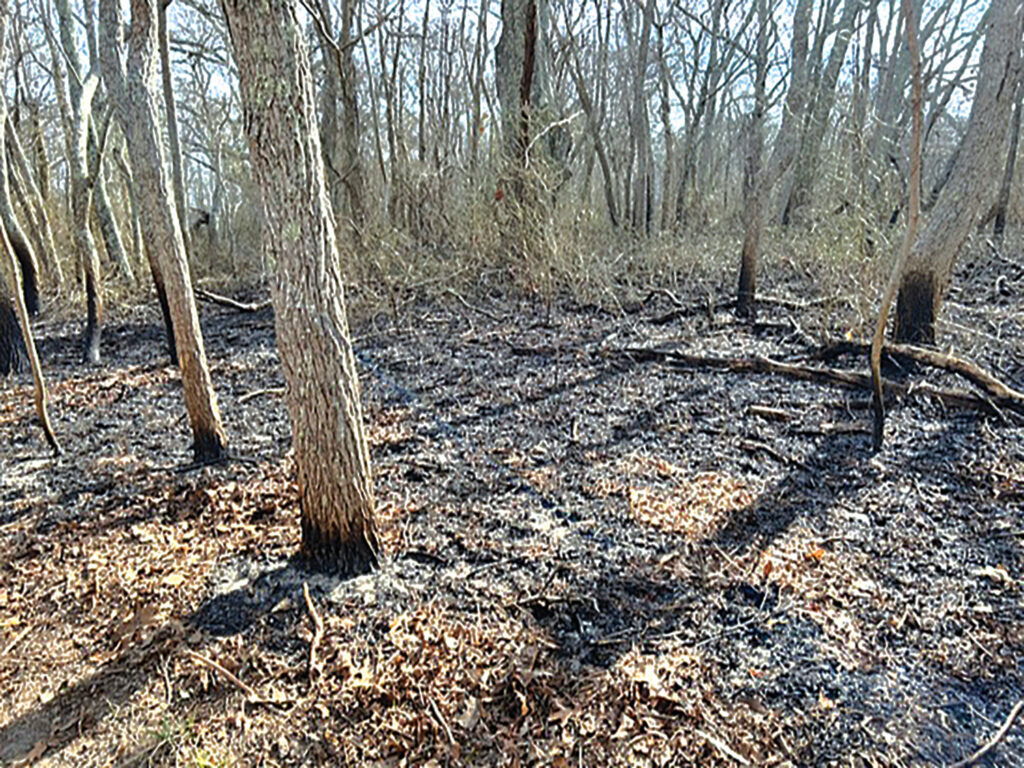
But on occasion, this scenario is no cause for alarm or worries since it is a beneficial sign that woodlands are being protected. A “prescribed fire,” often called a “controlled burn” is on now at Mashomack and will continue through Dec. 20.
According to The Nature Conservancy, which owns and manages Mashomack, “A prescribed fire, which is weather and conditions dependent, is a land management tool in which fire is intentionally applied to vegetation. The proper implementation of prescribed fire is not only great for the health of oak forests — suppressing invasive species, prompting biodiversity, and promoting oak regeneration — it also has important benefits for people, reducing tick habitat and abundance as well as abating wildfire risk by reducing forest fuel buildup.”
This is not new, since the last prescribed fire was in March at Mashomack, where 80 acres of woodlands was burned, bringing the total acreage of forest consumed to 180 from a previous burn when 100 acres were fired.
And it’s not new in human history, either. Indigenous people have used controlled burns for centuries, long before the Europeans arrived in the Americas. The new arrivals quickly adopted the practice.
According to authors A. Sydney Johnson and Philip E. Hale, “Indigenous cultural burns focus on what needs to be burned to revitalize the land with the intent of returning to make use of it again. Traditional baby baskets of the Yurok and Karuk Northern California tribes, for instance, are made from hazelnut shrub stems that are collected after fires.”
Fire, according to The Nature Conservancy, helped form the woodlands of Mashomack. In the early part of this century, Marc Abrams, Ph.D., a professor of ecology at Penn State, conducted what is a called a “forest health study.” He found evidence of prescribed fires in the past, and his research also turned up the fact that the lack of fire in more recent times has contributed to Mashomack’s problems regenerating oak trees
“Oak forests evolved in the presence of recurring low-intensity fires,” according to The Nature Conservancy.