Running 7 marathons in 7 days on 7 continents
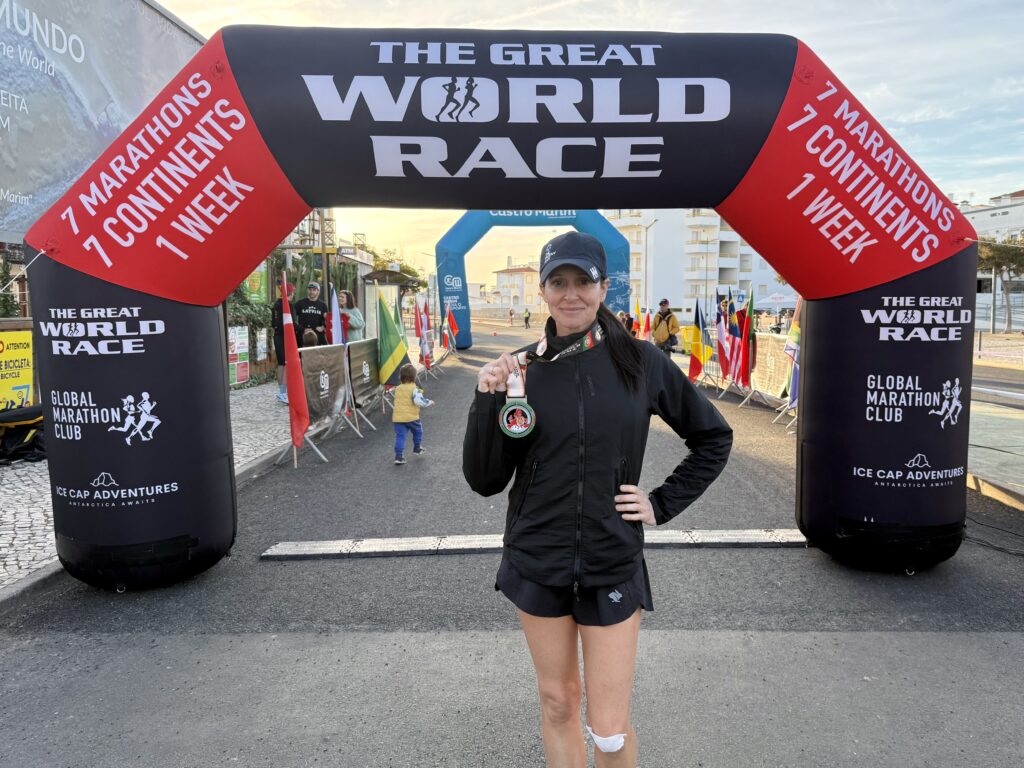
When Jennifer Rowe’s father, Alan Dowling taught her to sail a Hobie Cat on West Neck Bay as a girl, she took to it. Heedless of the wet, cold, and windy aspects of the sport, her enthusiasm for enduring some discomfort in pursuit of a goal was a sign of what was to come.
Ms. Rowe’s family history on Shelter Island goes back to the middle of the 20th century when her grandfather and his two associates bought the former Faith Baldwin family estate and named it Hilo Shores. Ms. Rowe spent her childhood summers on the Island, and now stays in the family house in Hilo with her husband Matt Rowe and their children.
She started running in 2013 to get back in shape after pregnancy, running in Central Park and Shelter Island. She likes the fact that running, unlike sailing, does not require equipment — “All I needed was a pair of shoes.” Soon Ms. Rowe was running 10K races with people telling her that if she could run a 10K, she could run a marathon. “Running on Shelter Island is great. It’s such a friendly place to run, people wave to you,” she said. “The hills are awesome.”
Her first marathon was Paris in 2014. “It was crowded, but it felt like an opportunity to see Paris as a local, and I discovered city marathons as a way to travel,” she said. When she completed the Greenland Polar Circle Marathon in 2015, Ms. Rowe realized that she really liked running in extreme cold. “It was a very small race run on the ice cap. I needed to use spikes for the entire race,” she said. “It opened my mind to doing very challenging runs in extreme places.”
Her Shelter Island training helped her master the technique of running in ice and snow. “Running on the beach mimics running in snow because your foot slides in a similar way,” she said. “I did a lot of my training on Shell Beach, where you can just keep going in loops over varied terrain.”
She ran the Berlin marathon in 2015, the Boston marathon in 2018, and the New York Marathon in 2018. In 2024, she ran the Polar Night Marathon in Tromso, Norway; 42 kilometers on ice and snow with spikes on her shoes. In the dark.
In 2024, Ms. Rowe and her family bore the sudden loss of her 31-year-old brother, Alan Dowling. When she lost her job a few months later, she decided the time had come to change her life. A notice for The Great World Race, seven marathons on seven continents in seven days, came up in her Instagram feed, and she felt it as a message. “My brother was so full of potential, and he never had the opportunity to take a chance on an adventure,” she said. “That showed me how important it is to go for it. So many people believed in me and thought it was possible, that I turned this unfortunate layoff into a fortunate thing.”
She was 47 years old, with six children and a supportive spouse, and during the four months of training, she learned that the primary obstacle she faced was her own fear of failure.
The months of intensive training meant distance runs every day and three 20-plus-mile runs every week. In early November, she boarded a plane for Cape Town, South Africa, to join about 60 other runners who would seek to complete The Great World Race, starting with back-to-back marathons in Cape Town and Wolf’s Fang, Antarctica.

The marathoners expected nasty conditions in Antarctica, and Wolf’s Fang did not disappoint. “We had wildly cold and windy conditions,” Ms. Rowe said, “Zero degrees and minus 37 degrees with the wind chill. I had three layers: gloves, mitten, and a heavy leather ski glove with handwarmers. Taking off the gloves to eat a gel was borderline dangerous.” She still has no feeling in two fingertips, but she finished second among the women runners.
The third marathon, in Perth, Australia, was Ms. Rowe’s worst, plagued with persistent nausea. She tripped and fell but finished the race. The fourth marathon in Abu Dhabi was supposed to be the hardest day. They had just come from 93 degrees in Perth and Abu Dhabi was hot, humid and the air quality was terrible. “But I felt fantastic,” she said.
This was the moment her running coach had predicted she might feel spent, but Ms. Rowe knew that she would finish the three remaining marathons. Instead of feeling like quitting, she said, “There was no doubt in my mind that even if I had to crawl, I would finish all of them.” And finish she did, polishing off the fifth marathon in Algarve, Portugal, the sixth in South America on the coast of Cartagena and the seventh in Miami, Fla., on Nov. 21.
“There are days when I’m not excited about running. But having a race as a goal helps me stay mentally engaged. In a race, there is a feeling that everybody has trained hard and you are all competing against your best self. In the final push, I try to visualize the finish line and it keeps me going.”
Ms. Rowe credits Shelter Island for its beautiful and challenging routes and the encouragement of those who run here. “It’s not about the race,” she said. “Follow the plan and you can do this. Running is one of the most approachable sports. You don’t need to join a gym or get a court. You can just do it.”