Anders Langendal: From Sweden to Shelter Island and keeping it all in the family
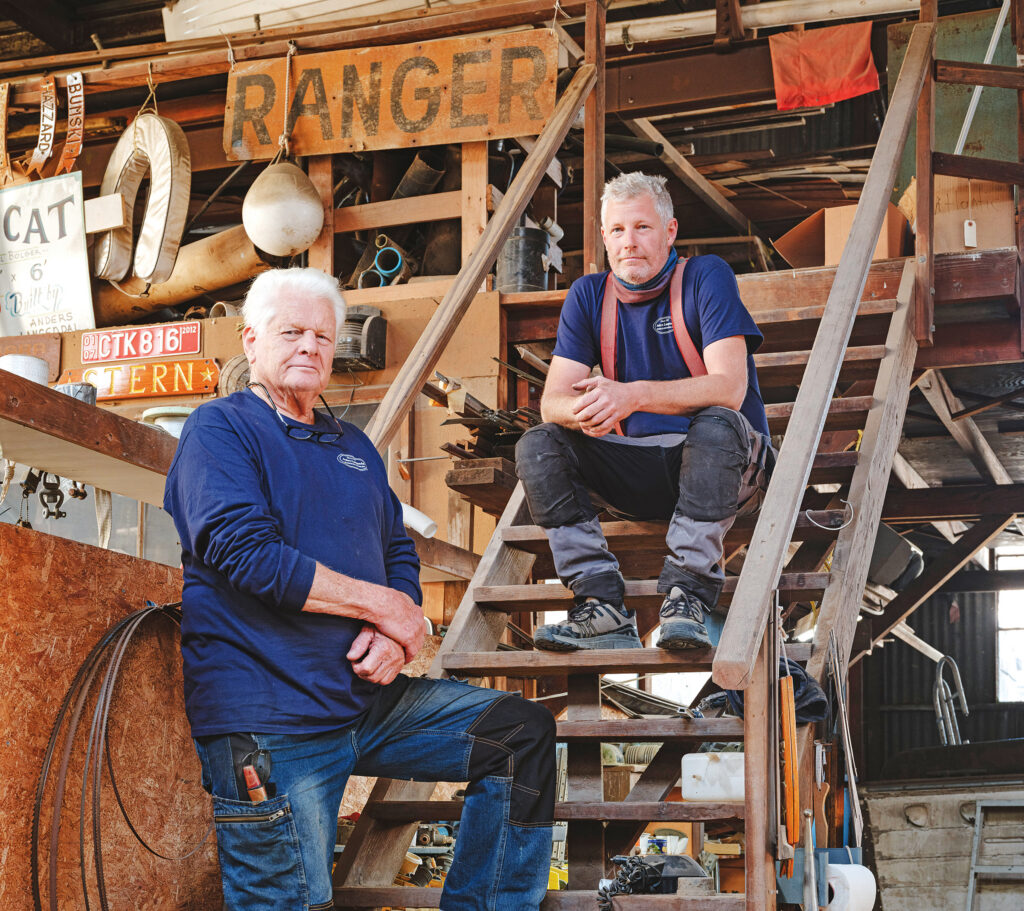
Carpenter Street in Greenport doesn’t have the same bustle typical of Front or Main. Those thoroughfares are often chock-full of shoppers and strollers exploring and enjoying the small-town, maritime-skewed vibe of the North Fork hub that’s filled with sea-centric trinkets and T-shirts, oysters on the half, bowls of chowder and other salty souvenirs.
But even with Greenport Harbor Brewing and, more recently, Little Creek Oysters taking up residence on Carpenter, it remains a quiet section of the village where it looks like time has stood still. On the easternmost end of the street, dead-ending at a section of the waterside that most people don’t ever traverse, the real deal sits on 20 acres, give or take, of Greenport’s true maritime past.
It’s here, at the entrance to Clarke’s Boatyard, that you’ll notice the sea-blue sign affixed high on one of the old steel warehouses that dot the land: Since 1959 Anders Langendal & Sons — and beneath that, in all capital letters: BOATBUILDERS.
It’s a trade that Shelter Island resident Anders Langendal learned in his native Sweden, brought here 60 long years ago and taught to his sons, Erik and Christian. They aren’t the only ones on this strip of working waterfront, but the few other occupants here encompass so much more than the word “boatyard” might imply — of our past, present and working waterfront future.
THE YOUNG MAN FROM SWEDEN
At 82, Anders Langendal is a model of good genes and a testament to the positive side effects of a life spent on the sea. He still stands over six feet tall, with eyes as clear and blue as the Baltic Sea and a thick, cropped swathe of salt-white hair that sits like foamy waves atop his head. The pockets of his Swedish-made carpenter pants (which everyone at the Langendal boatyard wears) hold more tools than most mortals have absentmindedly strewn in a junk drawer — a folding rule, myriad useful knives, a mallet, a chisel.
Anders was born in Stockholm in 1944 and, as a teenager in 1959, began a five-year schooling stint to learn to become a skilled boatbuilder. At the end of his apprenticeship in 1965, he built a boat so sea-sound and stunning it won first prize in the Stockholm International Boat Show, with his diploma and the spoils for winning presented to him by the king of Sweden himself.
A man with a summer house in Greenport heard of Anders’ skills and asked him to build a boat for his personal use. He was so impressed with the work that he offered an open invitation for the young European to visit if he ever came to the U.S.
“I had a good life in Sweden, but I was 21 and I wanted adventure,” Anders says.
He took his prize winnings, bought a one-way ticket to America and found his way to the sleepy seaside village and the boat he’d built, which happened to be in the very shipyard where his family business would eventually find its home of the past 30 years.
“In those days, they had first-, second- and third-class carpenters and my dad started as a third-class,” says Erik. “In just three months, he went from third-class to first-class carpenter. He became a hot shot pretty quickly and then he went out on his own.”

The way that happened was similar to the instinct-following path Anders took to land on the North Fork initially. One night, he was invited to the open house of the Harbor Inn, a bar on Shelter Island that had just gone under the ownership of a retired New Jersey policeman named Jack Cahill. The free beer flowed and Anders and Cahill hit it off. Cahill offered him the cottage in the back for $7 a week and the young Swede moved to Shelter Island, where he’s been ever since.
“I moved into that little room — it was a pretty rough place. Sometimes I’d bartend and, of course, I met everybody there,” he recalls.
If he received a bit of side-eye initially — this young, handsome foreigner making waves on the waterfront — his talents quickly won over fans and friends. “I worked in all the yards around here,” he says, “from Greenport to Southold, some over on the south side.” In 1966, Anders picked up work in Coecles Harbor, but after two or three months, he found it wasn’t challenging or matched to his skill set. “I was kind of bored there,” he says, recalling the afternoon that changed everything. He was driving past Klenawicus Airfield and pulled over.
“I stopped and lay down on the grass. I said, ‘What can I do now?’ It was a nice summer day and so I started to think, ‘I’ve gotta start my own business.’”
As he built more boats (and a few planes, including a replica of a 1917 British fighter plane and a rebuild of an Aeronka, painted red, white and blue for the 1976 Bicentennial, Anders’s reputation grew as the skilled carpenter from Shelter Island-by-way-of-Sweden. He made friends and lifelong colleagues. He met his wife, Marcelle, in 1975 when she was waiting tables at another one of the Island’s lost-but-not-forgotten salty dive bars, the Dory (she later founded the Hayground School in Bridgehampton). Soon after, the two married and started a family — bringing Erik and then Christian into the world and, eventually, as the next generation of boatbuilders.
DOCK OF THE BAYS
Greenport is as good a place as any to take the temperature of the current state of economic affairs; maybe even the best place on eastern Long Island, with its dense swathe of shops and restaurants lining Front and Main streets and its position as a depot for public transportation (bus, train, ferry, and motor and sailboats).
It’s also a good spot to check the health of the maritime industry and culture that has grown up around it — or perhaps the reverse is true. Without the town’s working waterfront and skilled tradesmen like the Langendals, would all the rest of it have developed? Unlikely.
The shipyard, currently owned by Stephen Clarke, came to be in the early 19th century, when whaling boats, schooners, skiffs, sloops and other ships were frequent sights in the town formerly known as Stirling (then Greenhill, and eventually Greenport in 1838). By World War II, the yard employed as many as 1,200 men building 90-foot mine sweepers 24 hours a day, seven days a week. Years later, Clarke’s family bought the land and started Greenport Basin and Construction Company, later renamed Greenport Yacht & Shipbuilding, which is still extant.
Many of the shipyard’s rusting steel buildings come from the WWII days, according to Erik, but to wander among the acreage is to see all aspects of modern life on the water. There are boats, of course, lots of boats. Some look seemingly abandoned, but others are crackerjack sport fishing vessels or are purely for personal pleasure cruising, all ship-shape and dry-docked and awaiting repairs or a little spiffing up. Erik and his partner, Samantha Ross, live on their boat here, snuggled up to a floating dock, during warm months. In the winter, they live in the old Langendal family home in Shelter Island’s Westmoreland Farm and Erik boats to work in a 17-foot 1972 center console Aquasport, a petite vessel that suits him just fine.
In one section of the yard where Costello Marine uses some space, pilings are stacked high, ready for slip construction. They also have their barges serviced here and use the yard as a place to load materials for dock- and slip-building jobs. In the distance, the remnants of what’s left of the Islander — a decommissioned old Shelter Island ferry boat — sit, awaiting their final fate as scrap.
The shipyard is a living, historical, very much still-functioning organ of the maritime body of Greenport. And in the same way you might not know how well your aorta is functioning beneath the surface, the workings of the yard tell quite a story about the importance of the boatbuilding and boat repair industries here. When Anders first landed in Greenport, there were 50 employees at the shipyard. Today, between the Langendals and Greenport Yacht & Shipbuilding, there are maybe 10 full-timers total.
It’s the one place where the ferries for both the North Ferry Company and the South Ferry Company are maintained and repaired, often swiftly and by men like longtime Greenport Yacht & Shipbuilding employee George Van Etten, who’s worked here for 25 years and could tell you more about those boats than a stack of encyclopedias (or, perhaps, ChatGPT).
One icy winter afternoon, he, Erik and a few others are tending to the Mashomack, one of the newer 20-car ferries. It sits up on what can only be described as a very carefully planned to the nth-inch set of stacked wooden cradles holding the mighty behemoth safely aloft so they can do the necessary repair to a propeller and get it back into Peconic Bay.
While Erik’s skills are centered in traditional boatbuilding, he also has a degree in civil engineering and works closely with Van Etten during the laborious, nearly two-hour task of carefully hauling the ferry in from the water and onto the maritime tracks used year after year, decade after decade, for this purpose.
“See these chains?” Van Etten says, pointing to the giant long links that pull the boats from the water. “Each one weighs 30 pounds and we make and repair them here.”
The yard is the only place the ferries are repaired on the East End. If and when it’s ever sold and the new owners don’t fancy becoming the proprietors of a working shipyard, the closest place the ferries can be serviced is Connecticut.
STAYING AFLOAT
Meanwhile, back in the Langendals’ workshop — also fittingly known as the Fleetwing Building, so-named for the high-end wood cabin cruisers that were built here in the 1920s — boats and boats and more boats come in and out all year long. In the winter, it’s repairs and fixes and spiffing. Years ago, many of the boats were commercial; these days, most of their clients have sport or leisure vessels.

In one special tented area, secluded to keep it a little warmer in cold months, Bianca Carranza, one of the Langendals’ skilled boat workers, patiently sands a Doughdish, a classic 12 1/2’ sailboat built for racing. She does this work, as well as the varnishing, mostly by hand. It’s a painstakingly slow and careful process meant to bring the wood back to a smooth, dazzling shine.
“See this?” says Erik, holding up a gracefully curved rib that will be used to construct a future fishing boat. “All four of the layers here are from a tree brought to us by [arborist] Dan Clark on Shelter Island. We milled it with a saw from Al Kilb. And now it will be part of a boat. You can’t get more local than that.”
Erik has been fully immersed in the business since 2002; Christian, who also lives on Shelter Island with his wife, Nina, and their three children, joined the family business around 2005. A year and a half ago, he accepted a full-time position with Coecles Harbor Marina. With the shipyard’s future seemingly in the balance, the younger Langendal needed to make the decision of a father and not a son.
“Every business in 50 years is going to evolve a major amount,” says Erik. “There used to be more fishermen but the fishermen can’t keep up their boats anymore.”
“It’s less commercial now — we do a lot of sport fishermen and we have a lot of the little [Doughdish] boats,” Anders adds. “About 50 or 60 that we service.”
Servicing is constant. In addition to general wear and tear, as racing boats the Doughdishes tend to collide, causing myriad mayhem in the form of cracks and broken parts that the Langendals know well how to fix.
And then there’s the ferries, of course — the lot of the Langendals’ shipyard neighbors, to whom Erik is ever-happy to give a mathematical assist with the complicated dry-docking procedures, in the name of helping with the constant flow of ferries that need to be serviced to and from his hometown.
“It’s a commercial yard and we all work together,” says Anders. “They help us, we help them.”
This story orginally appeared in Times Review’s northforker magazine.