Burning the land to save the landscape
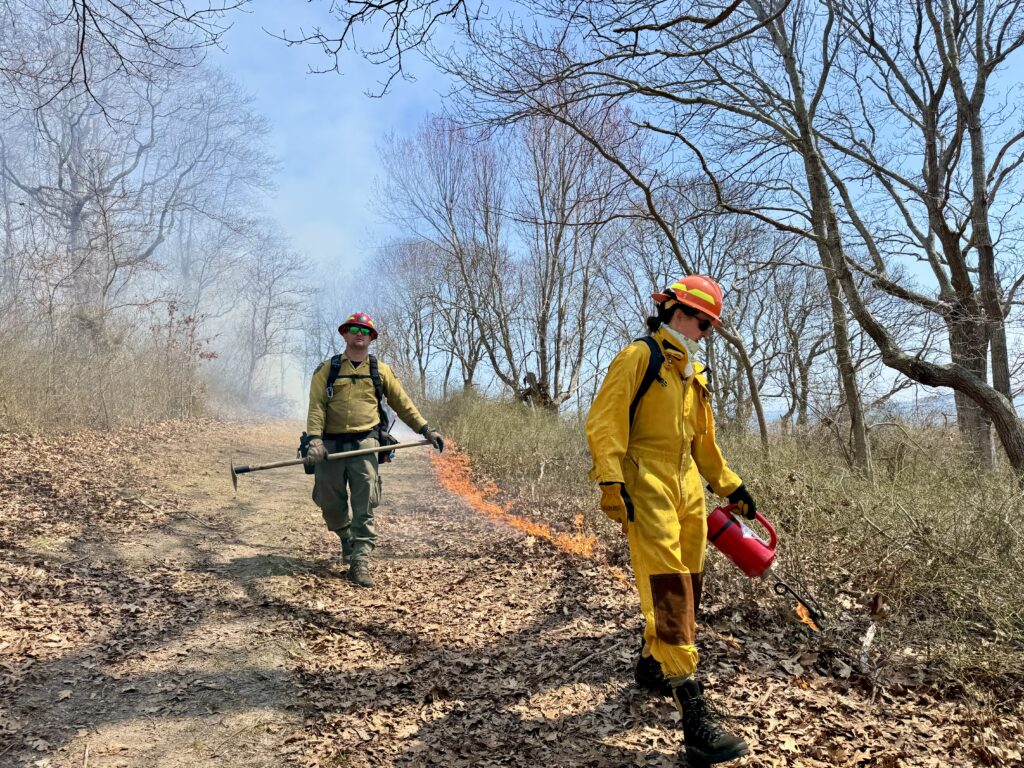
The white smoke that billowed from three fires along the eastern side of the 2,300-acre Mashomack Preserve and wafted toward the Atlantic Ocean on Friday, April 10, may have caused some worry, but it was a solid step forward for the health of the forest managed by The Nature Conservancy.
The smoke generated during what’s called a “prescribed fire” — the second one at Mashomack in the past year — took with it a lot of unwanted biomass, including acres of an invasive briar called smilax, and left the 265 acres that were burned a better, healthier forest.
This ancient form of land management has been practiced on Long Island since long before European settlers came here, but the prescribed fire of today looks different, with the precision timing and exacting execution of a military campaign.

It was a massive undertaking, bringing together 26 fire workers from The Nature Conservancy, the State Department of Environmental Conservation, and State Forest Rangers, spearheaded by Mashomack Stewardship Manager Cody-Marie Miller, who also organized last year’s burn. This year’s Burn Boss, Sasha Berleman, works for The Nature Conservancy in the Appalachian area. She was accompanied by her dog, Loki, who proved to have nerves of steel, a sunny disposition, and a knack for avoiding smoke.
The people who elected to spend a beautiful spring day walking for miles through smoky, tick-infested areas overgrown with catbriar and deep with leaf litter gathered at the Manor House at 9:30 a.m. wearing masks, gloves and fire-resistant garments. By 11 they were on the way to their stations, preparing to simultaneously fire-up three adjacent areas.
Ms. Miller was in charge of the Alpha segment, coordinating six fire professionals in the field as they burned the northernmost section.
Tom Dooley, who works with The Nature Conservancy in North Carolina said he was “glad to be back on Long Island, setting things on fire,” explaining that he has done prescribed burns on Long Island and elsewhere since the early 2000s. Mr. Dooley led the Bravo segment of eight professionals making fire do their bidding, a group that included Beau Payne, a member of the Shelter Island Police Department, who works on managing the deer population and advises Town committees.
Bryan Gallagher, a Shelter Island native, is a 27-year veteran State Forest Ranger who signaled his respect for the local fauna with thick sturdy tape binding his socks to his pant cuffs to protect himself from ticks. Officer Gallagher led the Charlie segment of N.Y. State Forest Rangers, and DEC Fish and Wildlife volunteers. He was fresh off four days of controlled burns on Long Island to control phragmites and improve duck habitat.
Go-time for a burn comes only when wind, temperature and relative humidity levels reach the prescribed levels. With time running out for the April burn window, the Friday action proceeded with a maximum forecasted temperature of 57, winds southwest at 10 mph, increasing to 15, and a chance of rain overnight.
“Compared to our prescription, that’s pretty much right in that desirable range,” Burn Boss Berleman told the crew at the pre-burn briefing.
Miller said her Alpha group “got fire on the ground at drop point 1,” finished ignitions around 3, and then patrolled the line and mopped up any fire or smoke that would threaten containment of the prescribed burn. By 6 p.m., the team was ready for the debrief at the end of a long day.

The objective, to burn 50% or more of the target area, with the catbriar as a particular target, was met. “The fire behavior and fire effects were as close to ideal as we could have hoped for,” said Manager Miller.
One of the most difficult aspects of a prescribed burn is destroying invasives without harming trees, especially oaks which support biological diversity. “We had limited impacts on healthy mature oak trees,” Ms. Miller said. “We will assess post-burn impacts to oak trees and to other vegetation. With the fire behavior we observed, we do not anticipate impact to oak trees.”
With Friday’s burn safely and successfully concluded, Ms. Miller said prescribed fire is one of the essential tools for keeping Mashomack healthy in the future. “Land management is perpetual,” she added. “The use of prescribed fire is most successful when used routinely and in conjunction with other land management tools. We will be continuing to burn at Mashomack to encourage and improve forest health and make Mashomack’s forest resilient in the face of climate-driven change.”