Historian reveals Long Island’s Nazi connection in new book
This article first appeared in Times Review’s northforker magazine.
Just as Rosh Hashanah — the Jewish New Year — was celebrated at the end of September and Yom Kippur observed on Oct. 2, prompting a period of spiritual introspection, Christopher C. Verga, a historian and author of several books about Long Island history, has released his latest work, “Nazis of Long Island: Sedition, Espionage & the Plot Against America,” from Arcadia Publishing.
An instructor of Long Island History and Foundations of American History at Suffolk County Community College and an instructor in the Politics of Terrorism at John Jay College of Criminal Justice, Mr. Verga holds a Doctor of Education degree from St. John’s University. He also writes for Schneps Media and Newsday.
Writer, professor and weekly Reporter columnist Karl Grossman (see page 8) notes in the book’s foreword that “Nazis of Long Island … is a book about the American Nazi movement and the strong resistance to curtailing its spread.”
The book recounts several WWIIera incidents, some well-known to Long Islanders, such as the four German spies who landed on the beach at Amagansett in 1942 and were promptly spotted by a local Coast Guardsman and eventually caught.
Mr.Verga discusses a Nazi rally held at Madison Square Garden in 1939, complete with swastika banners, that Mayor Fiorello La Guardia allowed to proceed, and which attracted 100,000 people (including attendees, counter-protesters and armed police).
He references three separate spy rings that operated on Long Island, whose goal was to gather intelligence and cause damage to local military bases and steal technology from companies like Republic Aviation, Sperry Gyroscope Company, Westinghouse Electric and Ford Motor Company.
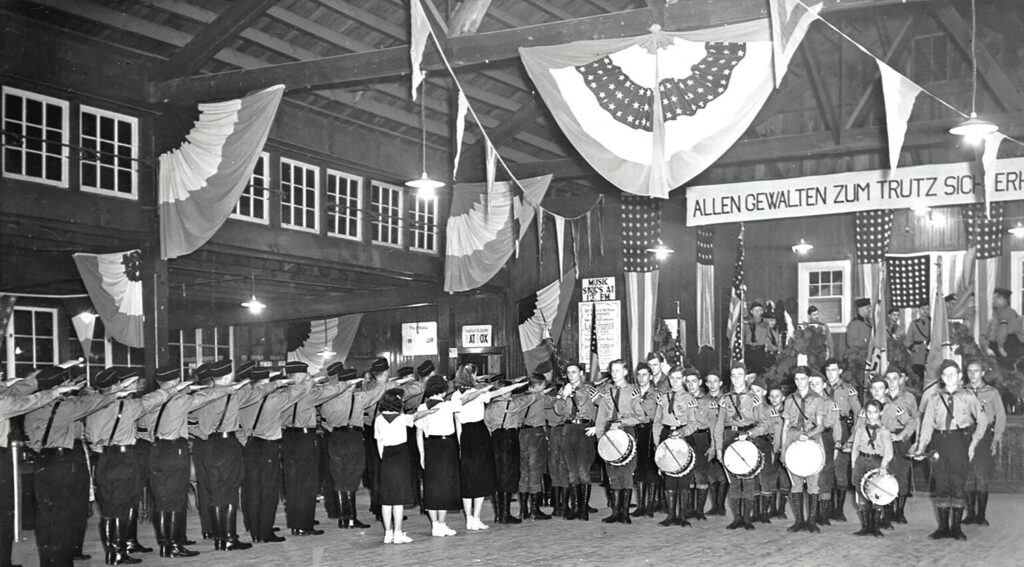
The German American Bund, an anti-government, pro-Nazi organization based in the Yorkville neighborhood of New York City, promoted Camp Siegfried in Yaphank, one of many summer retreats for Nazi sympathizers, where according to Mr. Verga. “Young campers were taught Hitlerism, discipline and militarism to prepare them for the future of the coming American Reich.”
After the war, Camp Upton, located where Brookhaven National Laboratory is today, and Mitchel Field in Hemp-stead served as reeducation camps for roughly 1,800 prisoners of war.
The Northforker spoke to Mr. Verga on the eve of his new book’s release.
Northforker: Have you always been interested in history?
Christopher Verga: I always had an interest in history. When I was studying in Europe — in Vienna — I went to Germany and visited many historical sites. Germans don’t really do small talk, but when you talk to them, they really contribute. They really recognize how [well] Americans treated them as POWs.
NF: You’ve done several books on Long Island history. How did you get interested in the topic of your current book?
CV: I do teach a Politics of Terrorism course. Right now, there is a real resurgence of right-wing groups. I wanted to know where that came from; is this something new, or is this an echo from history?
What’s that quote from Mark Twain? “History doesn’t repeat itself, but it often rhymes.”
NF: How long did it take you to research and write the book?
CV: It was about 16 months of research, at the National Archives, the New York State Archives, the Dewey Archives, the FBI files and the LaGuardia Papers (New York City Mayor Fiorello LaGuardia’s archives). The research took a while. It took longer to research than it did to write the book.
Many great photos came from the Longwood Public Library. They were really accessible; they have one of the best local history collections — I was very excited about that. Melanie Cardone- Leathers is an amazing archivist at Longwood and a great steward for our local history.
NF: What is the German American Bund?
CV: They were the foundation of the Neo-Nazi party. They were almost a cult in itself.
Every group evolves and changes their name; the best example is the Ku Klux Klan. It has evolved. The Bund is the parallel. They try recruiting young, angry people. Neo-Nazis are usually young and angry.
NF: In your book’s forward by Karl Grossman, he references what the Nazis did decades ago and what was done and not done to halt them. What should be done to halt those following in their footsteps now?
CV: I don’t have an answer — I wish I did. It’s very complicated. It’s important to have historical awareness. If people can identify patterns in history, they can see where we are headed today.
We do have a war on history. People are overly sensitive about us teaching what happened. People often ask me “why don’t you write about happy moments in history?” I write about what we overcame.
We cannot make our history propaganda. We must prevent revisions of history. When you have tragic incidents, you can’t look at it as the cost of progress. Historical awareness is key.
NF: You write about some tough topics like lynchings and slavery. What is the public reaction to your books?
CV: Students are very receptive. But when you do lectures, you find that sometimes it’s out of people’s comfort zones. People can be nostalgic about history; it becomes emotional. For the most part, I’ve been getting positive feedback.
Young campers were taught Hitlerism, discipline and militarism to prepare them for the future of the coming American Reich.
Copyright (c) 2025 TimesReview Newsgroup All Rights Reserved, Edition 10/2/2025
default
Top of Form
Bottom of Form
o