Talking Turkey: Sharing an Island with mysterious beings
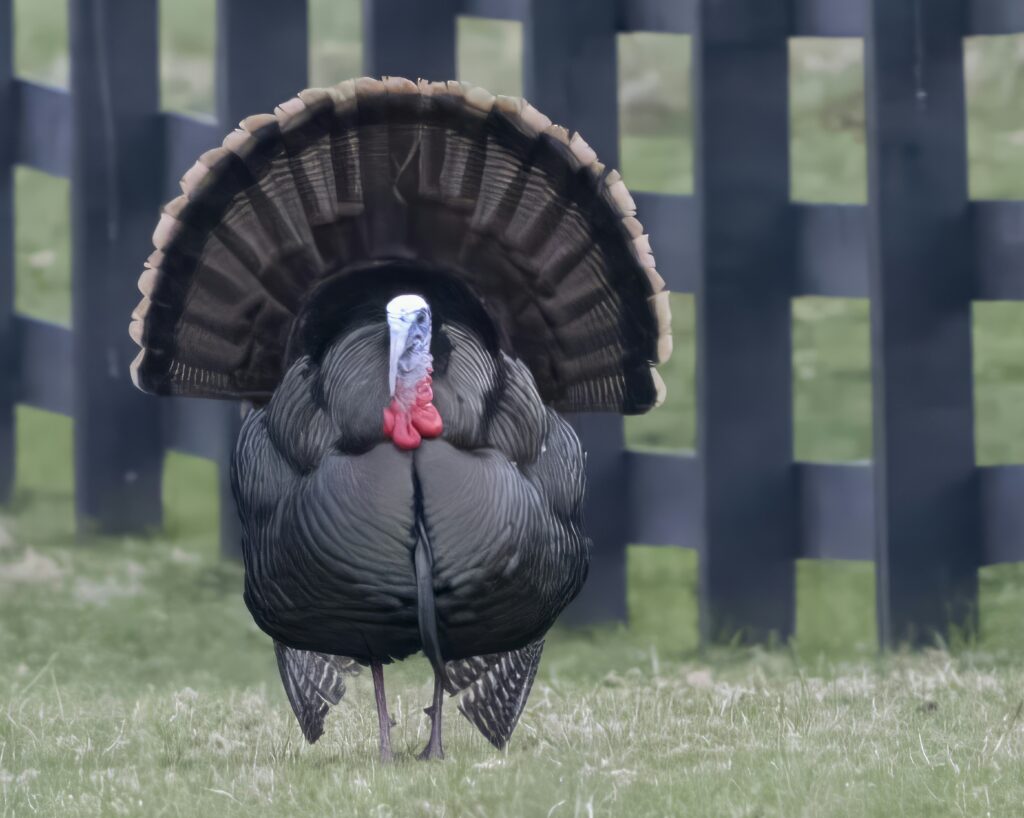
As every Shelter Islander knows, the last Thursday of November isn’t the only Turkey Day — try all 365 of them.
And no Islander knows this better than Animal Control Officer Jenny Zahler, who deals with turkeys that get hit by cars, get stuck in fences or, on occasion, has weirder encounters, such as a cannibal fowl and one who crashed through a window and wandered around the house (more on these incidents later).
Asked this week if there are more turkeys calling the Island home these days than in the past, Officer Zahler said that an anecdotal assessment would be that “more or less, there are about the same as last year.”
Trying to get a handle on numbers can come down to personal observation. “I got a call from Cathy Driscoll the other day who said, ‘What have you done with all the turkeys? There are none in my yard,’” Officer Zahler recalled. “I said to Cathy, ‘Well, they must have all come over to my place.’ This morning they were all over my deck and yard.”
Turkeys have made a remarkable comeback from a disease that seriously decimated the Island’s rafter. (Rafter is the correct word for a group of turkeys. At least that’s what author James Lipton, who wrote “An Exaltation of Larks,” maintains, and many ornithologists back him up. Lipton teased out the derivation of the term from a group of logs bound together to form a raft. Got that? Well, you’ll have to ask Mr. Lipton.)
A couple of years ago, Officer Zahler was busy with turkeys, but not so in 2024 or this year. In 2023, she had 59 calls about turkeys, all but two concerning birds in distress or the victims of accidents. The two were about bird pox. In 2024 she had 15 calls concerning turkeys, with two of those involving bird pox. In 2025, as of Nov. 24, there have been 16 turkey calls: zero were for the pox.
Bird, or avian pox, known by its clinical name of Avipoxvirus, is a virus that infects birds by insect bites, especially flies and mosquitoes, Officer Zahler said, although the virus can also be spread by contact with other birds. The symptoms can be seen as warts appearing, like running sores, especially around the eyes. If she sees a turkey “that looks like it’s fighting it off, with the warts drying up, I’ll leave them alone,” Ms. Zahler has said. “But I’ll see some that are losing the battle.” Those birds are then euthanized. Thankfully, for the turkeys, and Officer Zahler, the bird pox seems to be gone.
Foxes, who have a particular fondness for turkey eggs, have also contributed to keeping control of the turkey population. Back in 2018, red foxes made a comeback on the Island on the heels of a nearly decade-long decline in their numbers due to their susceptibility to mange, a disease caused by the mite Sarcoptes scabei. Although the Island’s fox population was never entirely depleted, it was drastically low for many years, with sightings of them few and far between.
But then for a time, the vibrant red canine appeared to be thriving once again. The fox population is cyclical and maybe nature’s cycle is spinning, so the turkeys are safer for now, although the future could become perilous for large rafters.
There is another predator, however, Ms. Zahler has said, that’s cutting into the turkey population. “People,” she said. One routine in her job is picking up dead or injured turkeys struck by cars. “I mean,” she said, “what’s the hurry? If you see a turkey in the road, please don’t be the guy who mows them down.”
Now, about avian cannibals and uninvited house guests. As we have reported, a few years ago, calls had come from several people about a particularly strange turkey. Police Officer Sean Clark also weighed in, starting his conversation with Officer Zahler by saying, “You’re not going to believe this.” A turkey was eating dead members of its rafter in and around Klenawicus Airfield.
Officer Zahler went by one evening and saw the bird, chowing down on a turkey wing. She said that it was a hen, and it was stranger still that it was alone on the ground, with the rest of the rafter roosting in trees, which turkeys do at night. It was one of the most baffling things Officer Zahler had seen in her years on the job. “Pretty scary,” she said.
Any more sightings of the cannibal? “No. Thankfully.”
According to the Merck Veterinary Manual: “No single cause of cannibalism in poultry has been identified, but genetics, crowding, excessive light intensity, and nutritional imbalances are correlated with its occurrence.” Not nailed down, but food (sorry) for thought.

And then there was the turkey who flew straight into a large window in Silver Beach, shattering it and ending up on the floor. “One of the homeowners was in the backyard with his dog when he heard this really loud smashing sound,” the ACO said.
After getting the call she went into the house. “There was glass everywhere. And lots of blood,” she said. But no turkey. She followed a trail of glass and blood. “I found it at the back of the house,” she said, with sadness but acceptance in her voice. “It had dragged itself there and died.”
The incident is an example of how powerful and athletic these seemingly clumsy creatures can be. “I love turkeys,” Officer Zahler has said, because of their personalities. “The domestic ones are really friendly. Once they get to know you, they come right up to you. They know I love them.”

As for wild turkeys, they’re just that, she noted, wild, and “definitely not friendly.” She added, “And should never be considered pets.” Treat turkeys the same as any wildlife: Observe and enjoy, but don’t interact unless absolutely necessary.
Our local turkeys can become truly annoying if a number of them decide to kick back on your patio or porch, as they did on the ACO’s place recently. One method to keep them from roosting near your favorite chair or strutting around the patio and interfering with the plants, is fencing, but that might not be too effective either.

Even though these comedians of the avian world look clumsy, they can fly (as the residents in Silver Beach dramatically learned) so hopping a fence is no problem. When they take wing, they’re as graceful as any bird, sometimes reaching speeds up to 50 miles an hour.
If you’ve ever been close to a wild turkey (and what Islander hasn’t), the first impression is how magnificently ugly they are, with the heads of space aliens and those dangling red wattles. Rara avis, they’re most content being earthbound, strutting around with the could-care-less attitude of bored aristocrats. They can also transform themselves in a flash into completely different beings, flaring out their feathers and changing the color of their fleshy necks to blue, gray or, being an American species, red, white and blue. The toms preen like this when they’re scared or angry or looking for love.
MYSTERIOUS BEINGS
How the birds got here in the first place is a mystery. The National Wild Turkey Federation has found there are about 7 million wild turkeys roosting in 49 states (Alaska is turkey-free), beginning to approach the numbers before Columbus landed, when there were about 10 million of them.

At the turn of the 20th century, it was a close call whether the wild turkey would survive. Hunting and loss of habitat were the factors decimating the American rafter. An act of Congress saved the American turkey from extinction with the 1937 Wildlife Restoration Act providing money for wildlife habitat enhancement programs. According to the Department of Environmental Conservation, turkeys were reintroduced to New York from Pennsylvania in 1959 when about 1,400 birds were let loose in the wild.
At one time there were so many of them in New York that the state exported almost 700 wild turkeys to Vermont, Massachusetts, New Hampshire, New Jersey, Connecticut, Rhode Island, Delaware and the Province of Ontario, helping to reestablish populations throughout the Northeast.
BORN IN THE U.S.A.
They’re called turkeys because of a British misunderstanding. Mario Pei, a Columbia University professor of Romance languages, has written that turkeys, though American born and bred, were imported to Britain after a stopover in the Middle East. The Brits called everything coming from that part of the world “turkey,” as in Persian carpets becoming “turkey” carpets.
Their All-American status was famously enshrined by Ben Franklin, who wanted to make the turkey our National Bird. It speaks volumes about Franklin’s personality that he preferred the basically gentle but fiercely independent (even cranky) turkey to the predatory bald eagle.
“The eagle,” Franklin wrote, “is a bird of bad moral character; he does not get his living honestly … like those among men who live by sharping and robbing … he is generally poor, and often very lousy. Besides, he is a rank coward; the little king-bird, not bigger than a sparrow, attacks him boldly and drives him out of the district … For in truth, the turkey is in comparison a much more respectable bird, and withal a true original native of America. Eagles have been found in all countries, but the turkey was peculiar to ours …”
Peculiar might be the last word, when it comes to all things turkey.