All in a day’s work for Island’s ACO: Bird flu cleanup, nurturing infant wildlife rescues
Animal Control Office Jenny Zahler has had a busy couple of weeks, cleaning up parts of the Island of dead wild fowl killed by bird flu. The ACO also had less stressful and more comforting duties, rescuing and caring for young wildlife (more later on this).

According to her records, Officer Zahler started removing dead or sick wild fowl from the Island — most of them from beaches— on March 7. By April 8, she had recorded 107 birds; all but five were dead and those were euthanized. Although it’s a large number, Shelter Island has been spared the horrendous losses of wild fowl, she said, that have struck other East End communities.
There have been hundreds, approaching thousands, of birds affected on the North and South forks. Just last week it was reported that 700 dead geese were collected at a pond in the Hamptons.
“Our numbers are not so many, when you compare,” Officer Zahler said. Asked why, she responded, “It could partly be that we’re an island, and sheltered.”
Bird flu, or Highly Pathogenic Avian Influenza (HPAI), has struck the East End this late winter and early spring because many birds’ immune systems were lowered due to starvation brought on by the fierce winter weather and snow cover, which restricted feeding places.
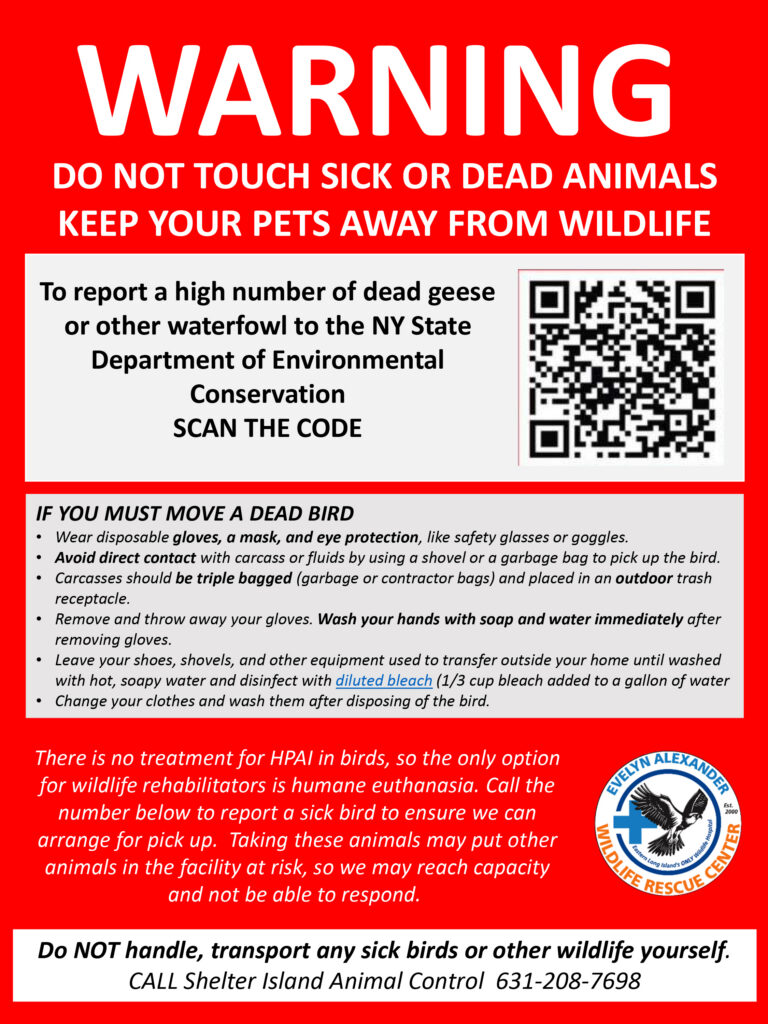
The Evelyn Alexander Wildlife Rescue Center has provided posters specially for Shelter Island that the ACO has placed around the Island where people either walk their dogs or stroll by themselves, alerting them to the issue.
Part of the posters states: “There is no treatment for HPAI in birds, so the only option for wildlife rehabilitators is humane euthanasia. Call the number below to report a sick bird to ensure we can arrange for pickup. Taking these animals may put other animals in the facility at risk, so we may reach capacity and not be able to respond. Do NOT handle, transport any sick birds or other wildlife yourself. CALL Shelter Island Animal Control 631-208-7698.”
According to the Centers for Disease Control and Prevention: “People rarely get bird flu, but when they do, it is most often after close, unprotected exposure (without wearing respiratory or eye protection) to birds or other animals infected with avian influenza A viruses. No person-to-person spread of bird flu has been identified in the United States at this time. Very rare, limited person to person spread has occurred in other countries.”
Several East End experts are sounding the alarm. “There’s plenty of reports of where [birds] are showing neurological signs when they’re alive,” said Jennifer Murray of Turtleback Conservation Center. “Their head tilts or swimming in circles, lethargy, and that’s what our Canada geese are displaying.”
The licensed rehabbers at Evelyn Alexander Wildlife Rescue Center in Hampton Bays are also on the case. “Every year we see avian influenza flare up around this time of year,” confirmed Ryan Gilmartin, an animal care assistant. “Last year in particular was quite bad. A lot of the domestic poultry farms were hit pretty hard, having to euthanize their flocks. A large amount came into our hospital [then], and we are seeing a large amount [of Canada geese] so far this year as well.”
Evelyn Alexander will take in sick and injured wildlife found east of the William Floyd Parkway if space at the facility allows.
Officer Zahler follows New York State Department of Environmental Conservation (NYSDEC) protocols by placing dead birds in heavy duty bags provided by the Highway Department. She praised the Department, especially employees Dave Clark and Bret Page for pitching in with the gathering and disposal of the dead birds. “They don’t to have do that, but they do,” she said.
One wild bird species that seems to have escaped the epidemic are the ospreys. The ACO explained that where eagles will eat carrion, and become infected, ospreys are fish hawks and not interested in road kill and other dead animals, but happily survive on fresh fish.
Beyond reporting mortalities, according to the NYSDEC, the public can help minimize risk and limit disease spread by preventing contact between domestic animals and wild birds. NYSDEC also warns to assume groups of birds found deceased are HPAI-positive and to avoid them.
Should removal be necessary, NYSDEC advises use of disposable gloves, a mask and eye protection. Avoid direct contact with the carcass by using a shovel and washing hands and clothing immediately after with soap and hot water. Carcasses should be triple-bagged and placed in an outdoor trash receptacle.
For more information on keeping other species safe from HPAI, such as song birds and home poultry flocks, see turtlebackconservationcenter.com.
CARING FOR THE MOST VULNERABLE
It was an extended Easter for ACO Zahler this week. She began hosting Easter bunnies (yes, plural) in the form of a litter of five wild baby rabbits.
Shelby Mundy had called Office Zahler to tell her she had discovered the litter. What was more urgent was the Mundy’s dog, an Australian Shepherd going by the name of Indy, had also discovered them in a shallow burrow.
“Once Indy knew they were there those bunnies were not going to be O.K.,” the ACO said, adding that mama rabbit “was probably off grazing somewhere.”
Wild rabbits breed, well, like rabbits, from February through September, according to Mass Audubon, with remarkably short gestation periods of about a month. The does give birth to from three to five litters every season with from four to 12 kits per season. The shallow burrows where the kits are born and raised are often lined in fur to keep the newborns warm.
Safe from the sniffing curiosity of Indy, Officer Zahler took the little rabbits to her home, where she is feeding them goat milk via syringe until they’re ready to face the world on their own, which can usually take about a month. “When they’re ready for a soft release, they’ll live in my yard, with all the other animals at Camp Jenny,” the ACO said with a smile.

Another rescue is a baby squirrel that she brought home and cared for in late February until it was time for a release. And then, not long after that, when gale force winds rushed over the Island bringing down trees, one came down and a nest of three more infant squirrels came with it. Those squirrels are now also staying for the time being at Camp Jenny.