Remembering Michael Coles: A very full life captured in the Islander’s memoirs
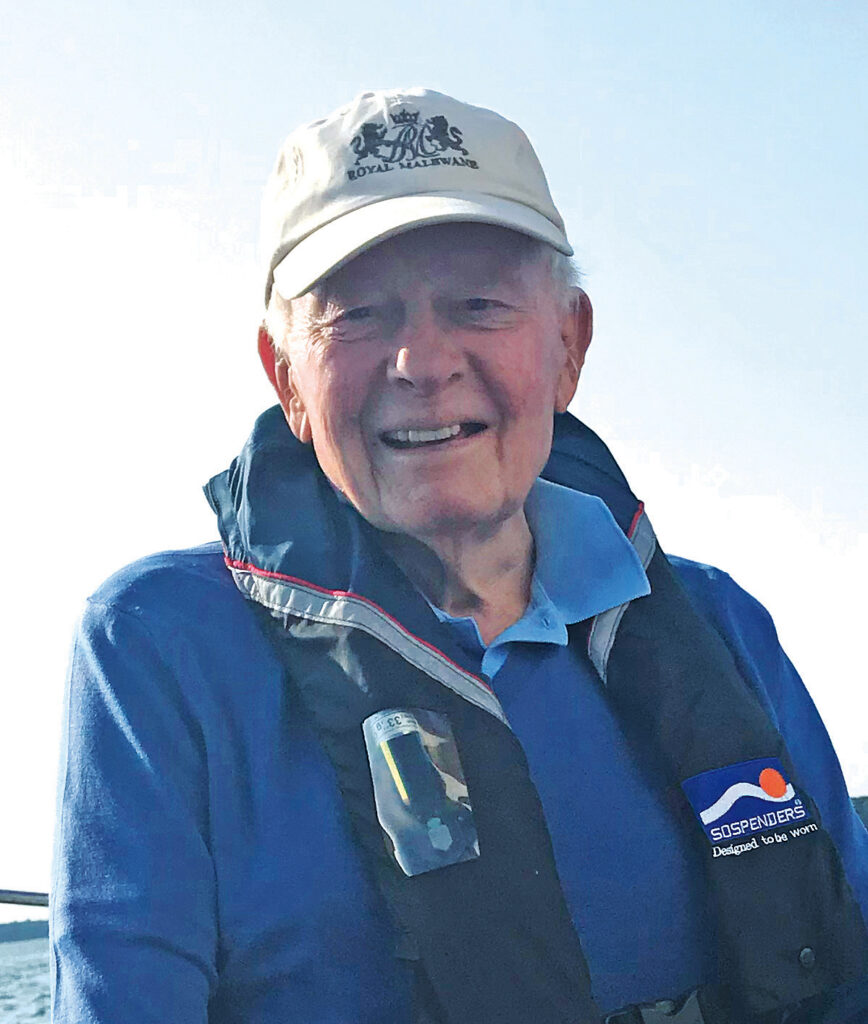
Mr. Coles passed away on Aug. 4, 2025 This story appeared in the October 9, 2020 issue of the Reporter.
When Islander Michael Coles’ book “A Boyhood in Wartime Britain” came to a close, readers began wishing to hear more from this witty, wise man who has been such a keen observer of the world.
Our wishes have been fulfilled, as his new book “Lucky, Not Smart” has just been published. Mr. Coles has packed several notable careers into his 80-plus years, and the new book shares with us his aviation exploits, maritime duty, courtship and marriage to his first wife, the late Joan Collins Coles.
Told in as self-deprecating a voice as possible without projecting false modesty, Mr. Coles gives Ms. Coles major credit for his going to Harvard Business School and succeeding in a career that took him to the leadership of Goldman Sachs.
Sprinkled with poetry and fond personal reminiscences of people important to him, from his family to fellow pilots, the book carries the reader quickly along. Robert Lipsyte, a noted author and writer of the Reporter’s Codger column, said he’s been encouraging Mr. Coles to write a followup to the earlier memoir and greatly enjoyed the new one. “He’s a natural, with a really good eye for detail,” he said recently. “It has a kind of jauntiness about it, like an Errol Flynn adventure.”
The stories flow smoothly, covering his service in the British Royal Navy during the Korean War and the civil war in Cyprus, as well as teaching other pilots. His rendition of the intensity of rocket-assisted aircraft takeoffs (“the most sphincter-tightening and mind-boggling experience of all”) is matched by the ardor that leaps off the page when he speaks of the courtship of Joan Collins. He describes her as looking like Grace Kelly but more beautiful, and supplies photos to bear that out.
There were obstacles to overcome before they could be married, from her Irish Catholic family in Boston to the inconvenient conflict in Cyprus. But there was indeed a wedding in Cyprus, followed by a honeymoon cruise to America on the S.S. United States. A family of five children came along in short order.
Joan Coles died in 1999 following a struggle with Parkinson’s Disease. A handicap-accessible trail in Mashomack Preserve, where the Coles family has been active and generous, is named in her memory. “After Joan died, I felt that life had come to an end for me,” he said. “Then I met Edie, and when she learned to her shock that I hadn’t become an American citizen, she said I needed to take care of that right away.”
Soon he would indeed be an American, and Dr. Edie Landeck would become his second wife. Among the lessons learned he cites in his book is, “One really happy marriage is a sign of considerable luckiness; two puts you well beyond the outer realms of probability.”
Dr. Landeck and Mr. Coles can be seen around the Island, stopping in Marie Eiffel’s for coffee or browsing at the Farmers Market. He describes great joy at knowing that his children and grandchildren have Island homes nearby. He has clearly embraced not only being an American but an Islander.
In addition to his philanthropic work for Mashomack, he recalled particular pleasure working with other Islanders on local projects, including a playground at the school and the conversion of the American Legion hall to a youth center.
Mr. Coles, after having a military career and earning an MBA at Harvard Business School, then rising through the ranks at Goldman Sachs to become Chairman of its International Corporation, earned a Master’s Degree in History from Columbia University. He’s published a nonfiction account of naval history, in addition to his earlier memoir.
Along with books by other Island authors, “Lucky, Not Smart” is available at Finley’s Fiction in the Heights.
Michael Coles: Now at one with history BY Jonathan Russo
Four years ago, Michael Coles looked at me with his trademark, mischievously twinkling eyes and flashed a wry smile. I was apprehensive. Did I write something wrong? Did I miss the point entirely? I exhaled when he assured me the question was spot on, but he wanted to emphasize a point that amplified the meaning. He wanted it to be more accurate.
Why Michael asked me to interview him for the library talk on his just-published, delightful memoir “Lucky Not Smart,” will remain a sweet mystery. I would never presume to think we were close friends. We were a generation apart, not to mention his quiver of accomplishments, philanthropic endeavors, board seats, community accolades, historical experience and family fecundity. Plus, he was an old-school gentleman, a man whose demeanor had no rough edges.
But we did have a shared passion. History.
Michael devoted the second act of his life to the study of history. More amazingly, through his memoirs, he wove the threads of his life story into the greater tapestry of military and social history. His mind was so expansive, so curious, that only the whole story of humanity could satisfy him. His delight at learning often resulted in a hearty laugh that resonated with irony and bemusement at the absurdity of it all. Even though he had graduate degrees in history, there was never a didactic aspect to him. Instead, he was playful, with a side of self-effacement.
Michael wrote about the big picture, like world wars, but there was an investment banker’s need to make sure the facts were right. Accuracy was not a luxury; it was a requirement. That is why working on his book talk was so challenging. He demanded we get it right. Not because of an ego requirement, but because he respected the audience.
Michael grew up in war-torn England but luckily managed to go to a prep school “deep in the countryside northwest of London and thus safe from German bombing.” War and violence were part of his youth.
Later, in military service, some of his fellow pilots didn’t make it back to the base. I got a strong sense from him that he felt each day was a gift. Not from a higher power, but the luck of the draw. Our one argument was my suggestion the book be retitled “Lucky and Smart.” Truthfully, he was smart as can be. Lucky was an add-on.
Michael’s breadth of historical knowledge was encyclopedic. When his friend, the late town supervisor Jim Dougherty’s late wife Nancy had her book on Nazi henchman Heydrich published, Michael already had a deep understanding of the man and his actions. At a lunch with the two of them, my head spun as they talked about the ramifications of Heydrich and how he affected every aspect of the Second World War.
When someone passes away, their loss is felt in a personal way. But sometimes the loss is even greater. A whole slice of history disappears as the knowledge Michael possessed melds into the cosmos. Fortunately, he left us a personal record of his allotted time here in his autobiographical books.
I already miss him.