Shelter Island’s vulnerabilities: Residents pack venue for Reporter Forum
Shelter Island, like all island communities, is vulnerable to natural events such as winter ice storms, nor’easters, hurricanes, rising sea levels, flooding and pandemics, as well as man-made crises such as cyber-attacks against governments. But islands have significant advantages over land-based communities.
These advantages were revealed at the Reporter Community Forum held at Fellowship Hall of the Presbyterian Church on Wednesday, Dec. 3, and were reiterated by several panelists throughout the evening. The advantages came down to two words: communication and community. And the first is made easier because of the second; a small island is a place where the sense of community is strong because of limited land mass and a small population, with bonds between residents widespread and strong.
Even when communication facilities are compromised or go silent, such as a scenario of the Island’s cell tower at the Recycling Center going dark, information will be passed by word of mouth. Places to meet are known, such as the Community Center or the school to assess the situation and get information from Town officials.
One of the panelists, Police Chief Jim Read, who is the Emergency Management Coordinator for the Town, said he was always amazed that some people, on hearing a threat of a severe storm coming to the northeast, would leave and head up-island. “This is the place you want to be,” the chief said, because the Island is set up for emergencies and that idea of communication and looking out for one another comes into play.
He noted an emergency during Super Storm Sandy in October 2012 when an EMS ambulance transporting a woman to Southampton Hospital couldn’t manage the ferry slip at South Ferry and a driver’s pickup was used to gain access to the ferry and get her safely across. During the same storm, power went out in the afternoon and the Fire Department Chief John D’Amato invited the Reporter’s staff to bring its equipment to the Center firehouse, which was running on a generator, so the paper could continue its work of informing the public.
One example of an engaged community was the Forum itself, with about 100 people packing Fellowship Hall on a Wednesday evening. It was the Reporter’s fifth Forum, titled “Shelter Island Vulnerabilities,” which were listed as the limitations of having one grocery store, one gas station, no pharmacy, limited physician hours, global warming, and an aging population with young families in short supply.
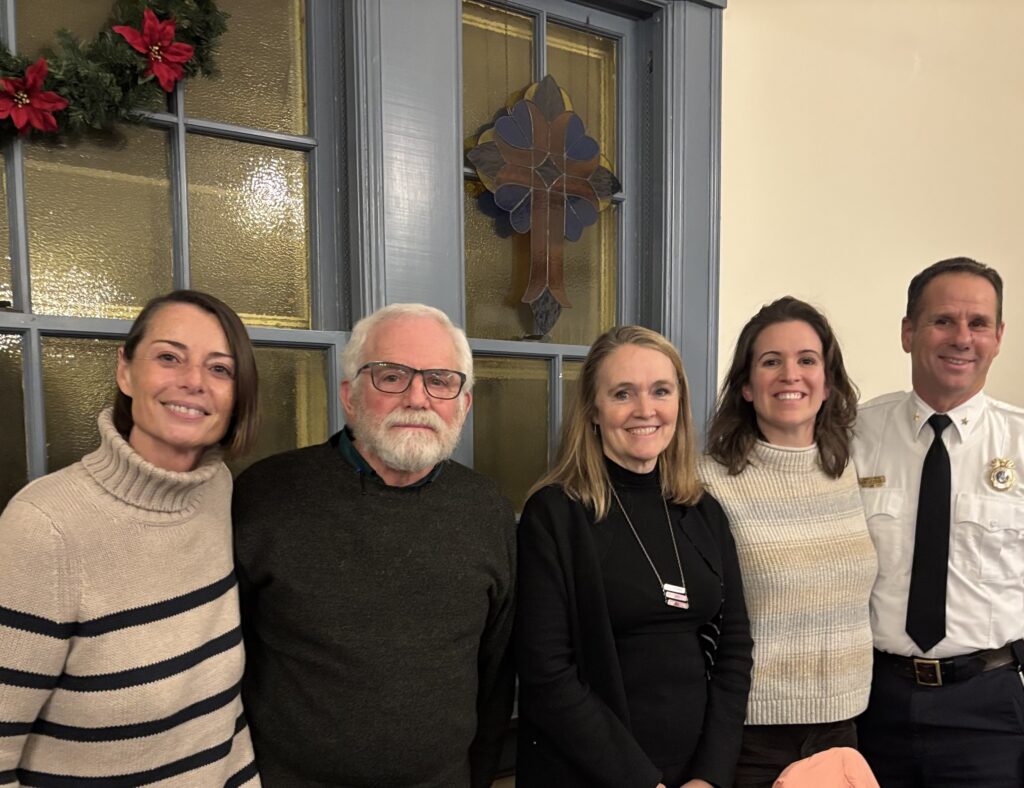
Sponsored by Dime Bank, Suffolk Security Systems, and Extreme AVS, the event was moderated by the Reporter’s Charity Robey. The panelists included, in addition to Chief Read: Supervisor Amber Brach-Williams; Chamber of Commerce V.P. Cristina Peffer; former Town engineer and North Ferry captain John Cronin, who is currently a Reporter columnist; and Kate Klibansky, a senior community development officer at The Island Institute. The Institute is a support organization for coastal and island communities facing climate and economic change. Ms. Klibansky came to the forum from her home in Rockport, Maine.
Times Review Media publisher Andrew Olsen greeted the audience and Ms. Robey posed her first question to Ms. Brach-Williams: “What, if anything, can Town government do to encourage cooperation between the Town and owners of private businesses that are vital to health and safety of Islanders?”
The supervisor mentioned the idea of constant communication and an ongoing “cultivation of relationships” with the ferry companies, Piccozzi for fuel supplies, and other critical businesses and organizations, so when a crisis occurs, partners are ready to work with the Town. Ms. Brach-Williams mentioned the Island’s response to the COVID pandemic, where she was the Town’s liaison to the Police, Fire and EMS departments, and worked closely with Chief Read to manage the crisis.
The COVID response was pronounced a success, with constant communication from Town Hall and through the Reporter, with two deaths recorded while other East End communities were severely struck; a series of vaccination events were set up on the Island and run without a hitch, vaccinating hundreds. Communication and efficiency were key, including with County and State representatives, which were, and are, maintained on a constant basis.
Chief Read said that the relationship with PSEG is a good one. The power company sends crews to the Island in advance of dangerous storms, with the personnel put up overnight and fed, and are then ready to go to work to restore power from downed lines. PSEG also maintains the lines and has regular tree trimming and hardening of infrastructure.
Ferries unable to operate because of storms have not been a factor, the chief noted. Ferries have been stopped in the past, not for days but just hours. Chief Executive of South Ferry Cliff Clark and General Manager of North Ferry Bridg Hunt were both in attendance and confirmed ferry service has been active through many emergences with only brief stoppages.
Ms. Klibansky also hit the note of the small-is-beautiful theme when it comes to surviving and managing a crisis. She said it’s also important to reach out for grants from private and public sources for essential infrastructure innovations and upgrades.
As for wildfires, which came dangerously close to doing real harm to the South Fork last year, and devastated the pine Barrens in 1991, Mr. Cronin noted that the risk of fire starting in wooded areas of the Island and leaping into residential communities is rare. The U.S. Forest Service indicates that Shelter Island has a wildfire risk lower than 70% of communities in the U.S.
But the risk is there, and if large fires occurred, it would be devastating. Steps should be taken, as they are at Mashomack now, of having controlled burns to eliminate underbrush, and to also make clear to residents that they should manage their properties to protect them from fires.
Top of mind for most Islanders has been the Soloviev Group shuttering the only pharmacy here, leaving residents vulnerable. Ms. Peffer addressed the issue, saying the vulnerability is real, describing the threat of “being on an island without a pharmacy, and a storm blows in, and we can’t get off.” She added that she’s been awakened with a 103 degree fever and no medication in the house; without a pharmacy this could be a dangerous situation.
“So bringing a pharmacy back here is one of the things I feel so passionate about, working with the Chamber to help make it happen,” she said, adding that she’s been working with people in Montauk, which lost a pharmacy and created a community pharmacy. “It was so inspiring to hear how Montauk came together … securing some funding” to make it a reality.
Talks are ongoing, Ms. Peffer said. “We are actively looking to set up a way to gather funding, find a location, and make this model work,” she added.
Mr. Cronin noted the very real vulnerability of being exposed to misinformation and disinformation spread by social media; of people living in news silos; and the lack of a sense of compromise. He said it has created an all-talk-no-action reality, citing four-hour-long board meetings of circular talk and debate.
This was echoed by an audience member, Kelci McIntosh, who received the greatest reaction from the gathering when she made a plea for affordable housing. She spoke of how vulnerable the Island is with an aging population and the flight of young people who can’t afford to live here. Creating housing at reasonable cost should be a priority. “Don’t vote on it, do it,” Ms. McIntosh said to a stirring round of applause.
Southold Town suffered a recent cyber-attack, and three years ago, a cyber-breach left Suffolk County systems in turmoil. It placed a heightened emphasis on the importance of cybersecurity for local municipalities that can be particularly vulnerable to threats. Asked about this, the supervisor said that Town Hall has been in communication with Southold and the County, as well as meeting with the Town’s IT department to identify vulnerabilities and methods to shore up systems against attacks.
Chief Read added that cyber security “falls within emergency management planning.” He is in constant touch with Southold’s Police Department. “Again, communication is invaluable,” he added.
At the finish of the Forum, the audience and panelists seemed to have a similar take-away: To be continued.